
Quick answer: For most healthy adults, flavour enhancers are not harmful at the levels allowed in packaged food. JECFA (the FAO/WHO expert committee) and EFSA have both reviewed MSG (INS 621) and found no harm from normal intake. Ribonucleotides such as INS 627, 631 and 635 are also permitted, though people with gout are advised to be careful. The bigger problem is usually what the enhancer sits in: salty, fried, heavily processed snacks. Infants under 12 months should not be given foods with added MSG.
Open a packet of instant noodles, masala chips or a soup mix and you will find a line on the ingredient list that reads something like “flavour enhancer (INS 627, 631)”. Most people skim past it. Some stop and wonder whether that line is the reason the snack tastes so good, and whether it is quietly doing them harm.
So, are flavour enhancers bad for you? The honest answer sits between two loud camps online. One says MSG is a poison. The other says the whole worry is superstition. The research supports neither claim in full. This guide explains what flavour enhancers are, what studies say about MSG side effects and long-term risk, how they are regulated in India, how to read a label, and where to buy either natural alternatives or food-grade flavour enhancers.
What are flavour enhancers and how do they work?
A flavour enhancer is a food additive that makes the taste already present in a food stronger, without adding a strong taste of its own. Stir a pinch into a plain vegetable broth and it suddenly tastes deeper and more savoury. That effect is called umami, usually described as the fifth basic taste after sweet, sour, salty and bitter.
The best-known umami flavour enhancer is monosodium glutamate, or MSG. It is the sodium salt of glutamic acid, an amino acid your body makes by itself. Glutamic acid also occurs naturally in tomatoes, mushrooms, cheese, soy sauce, peas and breast milk. When a food label says INS 621, it means MSG.
Food additives in India carry INS numbers (International Numbering System), which match the E-numbers used in Europe. These are the flavour enhancer numbers you will meet most often:
| INS / E number | Name | What it is |
|---|---|---|
| 620 | Glutamic acid | The amino acid itself |
| 621 | Monosodium glutamate (MSG) | Sodium salt of glutamic acid, the most widely used |
| 622 | Monopotassium glutamate | Potassium salt of glutamic acid |
| 625 | Magnesium diglutamate | Magnesium salt of glutamic acid |
| 627 | Disodium guanylate | A ribonucleotide, usually paired with MSG |
| 631 | Disodium inosinate | A ribonucleotide, usually paired with MSG |
| 635 | Disodium 5’-ribonucleotides | A blend of 627 and 631 |
Flavour enhancer 635 is really two additives sold as one blend. Manufacturers like it because MSG combined with a little 627 or 631 gives far more umami than any of them alone, so a small amount goes a long way. That is why you often see 621 and 635 together on the same label, and why searches for flavour enhancer 621, 627 and 631 tend to overlap.
Two numbers cause regular confusion. INS 330 is citric acid, an acidity regulator, and INS 322 is lecithin, an emulsifier. Neither is a flavour enhancer, even though they sometimes turn up in the same search results.
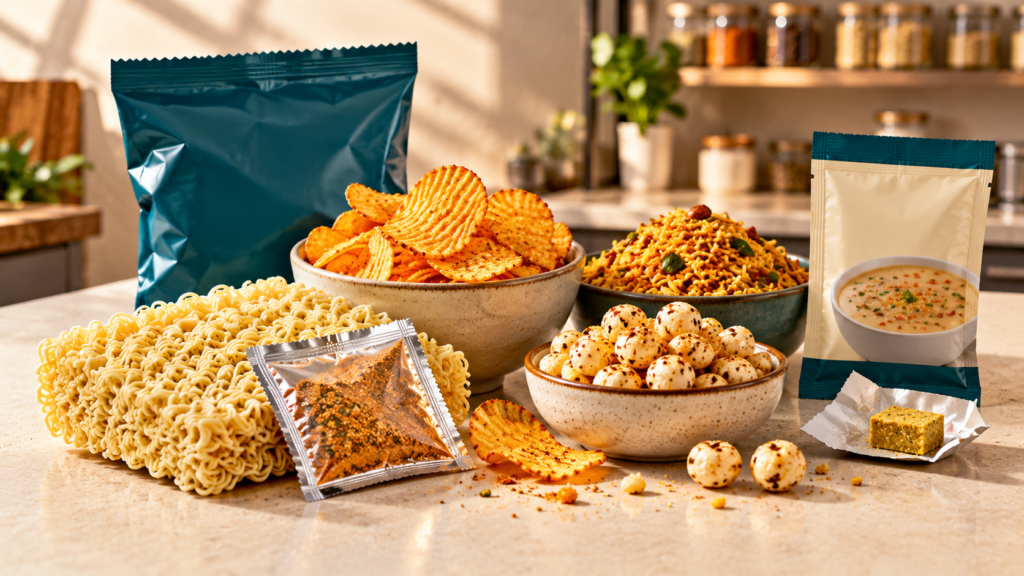
Which flavour enhancers are common in packaged snacks, and which foods contain them?
In the snack aisle you will mostly meet three things: MSG (INS 621), the ribonucleotides (INS 627, 631 or the combined 635), and savoury ingredients such as yeast extract or hydrolysed vegetable protein, which carry natural glutamate and do not need an INS number. Salt is also a flavour enhancer, and in most snacks it is the biggest one.
The amount varies by brand and even by flavour variant, so the label is the only reliable guide. These are the food categories where flavour enhancers show up most often:
- Instant noodles and pasta. The tastemaker sachet is usually where the enhancer is.
- Masala and flavoured potato chips. Seasoning powders often combine salt, spices and 627 or 631.
- Namkeen, bhujia, flavoured makhana and extruded snacks. Coated with a seasoning that has to survive frying and storage.
- Soup powders, stock cubes and gravy premixes.
- Indo-Chinese sauces and seasoning mixes. Schezwan and “Chinese salt” products are common examples.
- Ready-to-eat meals, frozen snacks and processed meats.
Restaurants and street stalls use them too, usually as loose MSG crystals, and none of that appears on a label.
Are flavour enhancers bad for health? What scientific studies say
What the regulators concluded about MSG safety
JECFA, the joint FAO/WHO committee on food additives, reviewed glutamates and placed them in its safest category, an acceptable daily intake “not specified”. The US FDA lists MSG as generally recognised as safe.
EFSA took a closer look in 2017 and did set a number. It gave glutamic acid and its salts (E 620 to 625) a group acceptable daily intake of 30 mg per kg of body weight per day. For a 60 kg adult that works out to 1.8 g of glutamate additives a day. EFSA said this level sits below the doses linked to headache, raised blood pressure and higher insulin levels in people. It also noted that some population groups could exceed the level through processed food, and asked for the permitted maximums to be reviewed.
In other words, regulators do not call MSG dangerous, but they do not treat it as something to eat without limit either.
Myth versus fact
Myth: MSG causes “Chinese restaurant syndrome.” The term goes back to a 1968 letter in a medical journal from a doctor who felt unwell after eating in Chinese restaurants. Later controlled trials, where people did not know whether they were getting MSG or a dummy, could not reproduce the reaction consistently. Some sensitive people do report short-lived symptoms after a large dose, mostly on an empty stomach, but the effect is not reliable and it fades.
Myth: MSG damages the brain. This one comes from a real fact. Glutamate is a chemical messenger in the brain. But glutamate in food is a different matter. EFSA notes that dietary glutamate is largely metabolised in the wall of the gut, and the gut lining uses it as fuel. Little reaches the bloodstream at normal intakes, so the idea that a bowl of noodles floods your brain does not hold up.
Myth: MSG is a chemical, but natural glutamate is safe. Your body cannot tell them apart. Glutamate from a ripe tomato and glutamate from MSG is the same molecule. The difference is dose. MSG lets a manufacturer concentrate it.
Myth: MSG is bad for bones. There is no established evidence for this in humans. The worry comes mostly from limited animal experiments. The better-documented dietary factor for calcium loss is high sodium intake overall, which is a problem with salty snacks whether or not they contain MSG.
Myth: a “no MSG” snack is a healthy snack. A chip without MSG is still fried and salted. And as explained below, a pack can say “no added MSG” and still contain glutamate from yeast extract or tomato powder.
Flavour enhancer side effects and long-term risks
Short-term MSG side effects, when they happen, are usually mild: headache, flushing, sweating, tingling or numbness in the face, palpitations and drowsiness. They tend to follow a large amount eaten quickly, and they pass within hours. Is too much MSG bad for you? Very large doses can cause these symptoms in sensitive people, which is the reason regulators set intake limits.
Long-term risk is where honesty matters, because the evidence is thinner than either side admits. No regulator has linked permitted use of MSG to cancer or diabetes. Some observational studies in Asian populations have connected high MSG intake with weight gain and metabolic changes, but these studies cannot prove cause, since people who eat a lot of MSG also tend to eat a lot of salty, calorie-dense food. Long-term controlled trials in people are limited.
Three concerns are more concrete than the rest:
- Sodium. MSG itself has about a third of the sodium of table salt by weight, but seasoned snacks carry salt as well. The WHO advises adults to keep salt under 5 g a day, and it is easy to pass that with instant noodles and chips in the same day.
- Gout. INS 627, 631 and 635 are purine-based and the body converts purines to uric acid. People with gout or high uric acid are usually advised to limit them.
- Infants. FSSAI requires a warning on foods with added MSG that they are not recommended for infants below 12 months.
This article is general information and not medical advice. If you have a health condition, ask your doctor which foods to avoid.
Are flavour enhancers regulated in India? What FSSAI says
Yes. The Food Safety and Standards Authority of India (FSSAI) controls flavour enhancers under the Food Safety and Standards (Food Products Standards and Food Additives) Regulations, 2011. MSG (INS 621) is not allowed in every food. FSSAI has stated that it can be added to specific categories such as seasoning for noodles and pasta, meat tenderiser, onion salt, garlic salt, seasoning mixes, rice toppings, fermented soybean paste and yeast, and it must follow good manufacturing practice.
Labelling rules apply as well. Under the Packaging and Labelling Regulations, a package or advertisement for food with added MSG must carry a declaration saying so, along with the line “Not recommended for infants below 12 months”.
There is one detail most people miss. In a 2016 order FSSAI acknowledged that there is no test to tell whether glutamate in a product was added as MSG or is naturally present from ingredients like tomato, milk or wheat. That is why “no added MSG” on the front of a pack is a claim about the recipe, not a guarantee of glutamate-free food, and why FSSAI said it would act mainly where a label claims “No MSG” but MSG has been added.
Which brands sell flavour enhancers in India, and are they safe?
There are two different things behind this question. The first is pure MSG, sold in small packs or loose, often called “Chinese salt” or under names such as Ajinomoto and vetsin. The second is packaged foods whose seasoning contains enhancers, such as instant noodle and soup brands like Maggi, Knorr, Sunfeast Yippee and Ching’s Secret. Whether a particular variant contains INS 621, 627, 631 or 635 depends on the product, so read the pack.
Any product sold legally in India has to meet FSSAI standards, and that includes the additive rules above. A brand name alone does not tell you how much of an enhancer a product contains. In 2015, FSSAI ordered Maggi noodles off the shelves over lead levels and labelling concerns. The Bombay High Court later set the order aside and the product returned after fresh testing. The episode showed how much scrutiny large brands get, but it is not a reason to avoid or trust a whole category.
This comparison of the main product types is more useful than ranking brands:
| Product type | Main ingredients | Sodium load | Who should be careful |
|---|---|---|---|
| Pure MSG crystals | INS 621 only | Low per gram, about a third of salt | Infants, people who react to large doses |
| Ribonucleotide blend | INS 627 + 631 (635) | Low, used in tiny amounts | People with gout or high uric acid |
| Masala or tastemaker sachet | Salt, spices, INS 621 or 635, sugar | High, mostly from salt | People watching blood pressure, children |
| Yeast extract seasoning | Yeast extract, salt | Moderate to high | People avoiding glutamate entirely |
| Mushroom or tomato powder | Single dried ingredient | Very low, no added salt | Generally no one |
How to check for flavour enhancers on a food label
- Read the ingredients list from the end. Additives are listed in a group near the bottom, often as “flavour enhancer (INS 621)” or “flavour enhancer (INS 627, 631)”.
- Look for the numbers 620 to 625, 627, 631 and 635. Any of them means an added flavour enhancer.
- Look for the MSG declaration. If the food has added MSG, the pack must say so.
- Check for savoury ingredients that work like MSG without the name: yeast extract, hydrolysed vegetable protein, tomato powder, soy sauce powder.
- Compare the sodium per 100 g in the nutrition table. This number tells you more about health than the additive does.
- Look for the FSSAI licence number. A 14-digit number on the pack shows the maker is licensed.
If you want to cut back without giving up snacks, use half the sachet of a noodle tastemaker and add fresh vegetables, or pick the plain variant of a snack and season it yourself.
Natural alternatives to artificial taste boosters for home cooking in India
Indian cooking already has a deep set of umami builders. If a dish tastes flat, try one of these before reaching for a packet:
- Onions cooked slowly until deep brown, then tomatoes cooked until the oil separates.
- Dried mushroom powder or finely chopped fresh mushrooms in gravies and pulao.
- Tomato powder or a spoon of tomato paste in dals and soups.
- Kasuri methi, crushed between the palms at the end of cooking.
- Amchur, tamarind or kokum for a sour note that makes salt taste stronger.
- Kala namak (black salt) for a sulphurous savoury edge in chaats, raitas and snacks.
- A tadka of ghee, cumin, garlic and curry leaves poured over dal at the end.
- Nutritional yeast or a small piece of kombu in soups and stock.
For a homemade seasoning powder, dry-roast cumin and coriander seeds, grind them with dried mushroom powder, tomato powder, black pepper, amchur and a little kala namak, and store it in a dry jar. Use it on roasted makhana, popcorn or fried snacks. It will not taste identical to a packet masala, but it is close enough to be worth doing, and you control the salt.
Where to buy natural flavour enhancers and food-grade flavour enhancers
For home cooks
Natural flavour enhancers are easy to find. Dried mushroom powder, tomato powder, kasuri methi, amchur, kala namak and nutritional yeast are sold on Amazon India, BigBasket, Blinkit, Zepto and JioMart, and at organic stores and local spice markets. Whichever you choose, pick packs with one ingredient on the label and an FSSAI licence number, and avoid “masala blends” that hide salt or added enhancers behind a friendly name.
For food manufacturers and snack brands
Businesses that need INS 621, 627, 631 or 635, or a finished seasoning, should buy from a licensed food ingredient supplier and not from a general chemical trader. Before placing an order, ask for:
- The supplier’s FSSAI licence number and a food-grade specification for the exact INS number you need.
- A certificate of analysis for each batch, including heavy metal limits.
- The dosage range for your product type, since a chip and a noodle sachet need different amounts.
- A sample to test on your finished product, not just on the powder.
- Shelf life, packaging size and minimum order quantity.
You can also enquire with TAG Ingredients India Pvt Ltd, a Gurugram-based supplier, for flavour enhancer and seasoning requirements. As with any supplier, ask for the specification sheet and a sample before you commit.
Quick answers to what people also search
Is too much MSG bad for you? Large single doses, several grams at once, can cause temporary headache, flushing or tingling in sensitive people. A pinch in home cooking is far below that. The risk comes from eating several MSG-seasoned packaged foods a day.
What are MSG side effects, and are there long-term ones? Short-term effects are mild and pass within hours. For long-term effects, some observational studies link high intake with weight gain, but they cannot prove MSG is the cause. The sodium in the food is the better-supported concern.
What are flavour enhancer side effects in general? For glutamates, mostly the short-term symptoms above. For 627, 631 and 635, the main issue is uric acid in people prone to gout.
Is MSG bad for bones? No established evidence in humans supports this. High sodium intake is the better-documented risk to calcium balance.
What is flavour enhancer 635? A blend of disodium guanylate (627) and disodium inosinate (631). It is used alongside MSG because the combination boosts umami strongly at very small doses.
Does MSG affect the brain? Glutamate is a brain messenger, but glutamate from food is largely used up by the gut and little of it reaches the bloodstream at normal intakes.
Is MSG bad for kids? FSSAI says foods with added MSG are not recommended for infants below 12 months. For older children, there is no evidence of harm at normal intake, but EFSA noted that some groups can exceed the safe intake level through processed food. It makes sense to limit instant noodles and chips, mainly because of the salt.
So, are flavour enhancers bad for you?
Not in the way the internet often claims. MSG and the ribonucleotides are approved, studied and regulated, and the dramatic stories about brain damage or bone loss are not backed by good human evidence. The genuine cautions are narrow: infants, people with gout, and anyone eating a lot of salty processed food.
The most useful habit is simple. Turn the pack around, find the INS numbers, check the sodium, and decide how often the food belongs in your week. Cook with real umami ingredients when you can.
Frequently asked questions
Are flavour enhancers bad for health according to scientific studies?
Studies on MSG at normal intakes have not shown harm in healthy people. JECFA gave glutamates an intake limit of “not specified”, and EFSA set a group limit of 30 mg per kg of body weight per day in 2017. A few sensitive people report short-lived symptoms after large doses. Long-term human evidence is limited, and the larger health issue is usually the salt and processing in the foods that contain enhancers.
What are common flavour enhancers found in packaged snack items?
The most common are MSG (INS 621), disodium guanylate (627), disodium inosinate (631) and the blend 635. Snacks may also use yeast extract or hydrolysed vegetable protein, which add savoury taste without an INS number. Salt works as a flavour enhancer too.
What are common brands selling flavour enhancers in India and are they safe?
Pure MSG is sold in small packs and loose as “Chinese salt”, sometimes under the name Ajinomoto. Brands such as Maggi, Knorr, Sunfeast Yippee and Ching’s Secret sell noodles, soups and sauces whose seasoning may contain enhancers, depending on the variant. Products sold legally must meet FSSAI rules, but you should still read the label for INS numbers and sodium.
Are flavour enhancers used in Indian processed foods regulated by any agency?
Yes. FSSAI regulates them under the 2011 Food Additives Regulations. MSG can be used only in specified food categories, must follow good manufacturing practice, and must be declared on the label with an infant warning for children under 12 months.
Where can I buy natural flavour enhancers instead of chemical ones?
Dried mushroom powder, tomato powder, kasuri methi, amchur, kala namak and nutritional yeast are available on Amazon India, BigBasket, Blinkit, Zepto and JioMart, and at organic stores and spice markets. Choose single-ingredient packs with an FSSAI licence number.
What are the potential long-term health risks associated with flavouring additives?
For flavour enhancers, the documented concerns are high sodium intake from salty processed foods, uric acid build-up in people with gout (for 627, 631 and 635), and possible excess intake by frequent snackers. Other flavouring additives are assessed one by one, so risk depends on the specific substance and amount.
How do popular flavour enhancer products compare in safety and ingredients?
Pure MSG has about a third of the sodium of table salt. Ribonucleotide blends are used in very small amounts and matter mainly for gout. Masala sachets are the highest in sodium because most of the powder is salt. Mushroom and tomato powders carry no additives. The table above sets out the comparison.
What are natural alternatives to artificial taste boosters for home cooking in India?
Slow-browned onions, well-cooked tomatoes, mushroom powder, kasuri methi, amchur, tamarind, kokum, kala namak, a ghee tadka and nutritional yeast all add depth without added enhancers.
Are flavour enhancers linked to any long-term health issues?
No regulator has established a link between permitted use of MSG and a long-term disease. Observational studies show associations with weight gain in some groups, but they cannot prove cause. The firmer links are between high sodium intake and blood pressure, and between ribonucleotides and gout flare-ups in susceptible people.
Which popular food categories contain significant amounts of flavour enhancers?
Instant noodles and pasta sachets, masala potato chips, namkeen and flavoured makhana, soup powders and stock cubes, Indo-Chinese sauces, gravy premixes and processed meats. Amounts differ by brand and variant, so check the INS numbers on each pack.