
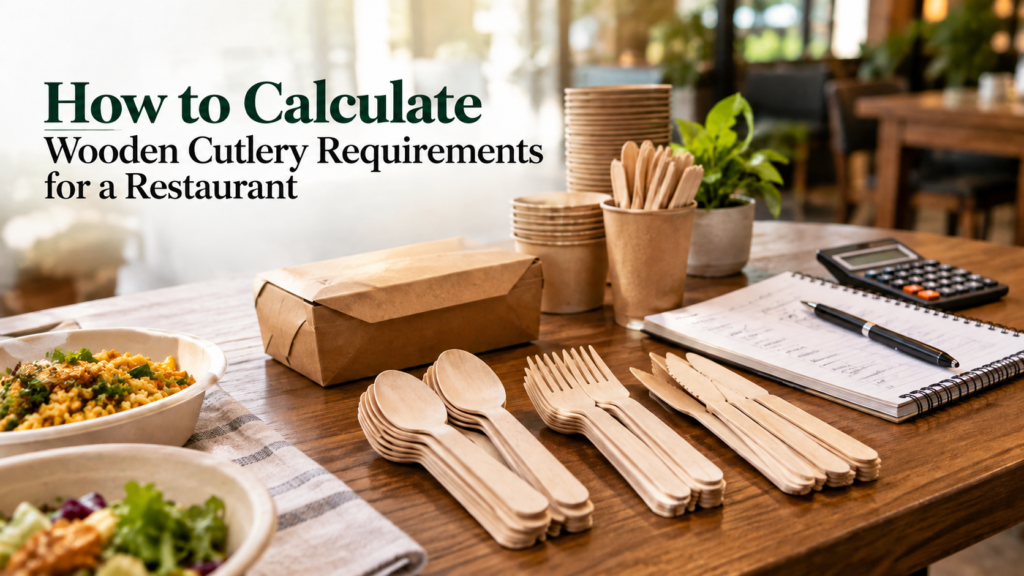
Most restaurant owners order wooden cutlery the same way they order napkins: by guesswork, a rough box count, and a bit of panic when the last packet of forks runs out mid-shift. That works fine until a weekend rush strips your cutlery drawer by 9 PM on a Saturday.
Getting your numbers right, from daily covers to your next bulk wooden cutlery order, is really a math problem once you know which figures to plug in. This guide walks through the exact formula restaurant supply planners use, the factors that push consumption up or down, and where restaurants, cafes, and cloud kitchens across India actually source disposable wooden cutlery in bulk.
What Is Wooden Cutlery and Why Restaurants Are Switching to It
Wooden cutlery — spoons, forks, knives, and stirrers cut from birch or similar light wood — has replaced plastic across a large part of Indian food service over the past few years. Some of that shift comes from regulation, since several states now restrict single-use plastic cutlery. Some of it comes from customers, especially the ones ordering from QSRs, cloud kitchens, and catering brands that want their packaging to look and feel eco-friendly the moment a delivery bag is opened.
Compared with steel cutlery, wooden pieces need no washing, no polishing, and carry no risk of quietly leaving the building in a takeaway bag. Compared with plastic, compostable wooden cutlery and biodegradable wooden cutlery break down considerably faster, which matters if your restaurant, cafe, or catering brand is making a sustainability claim on the menu or the packaging itself.
None of that helps if you don’t know how many pieces you actually need each week. That’s where the calculation comes in.
How to Calculate Wooden Cutlery Requirements for Your Restaurant
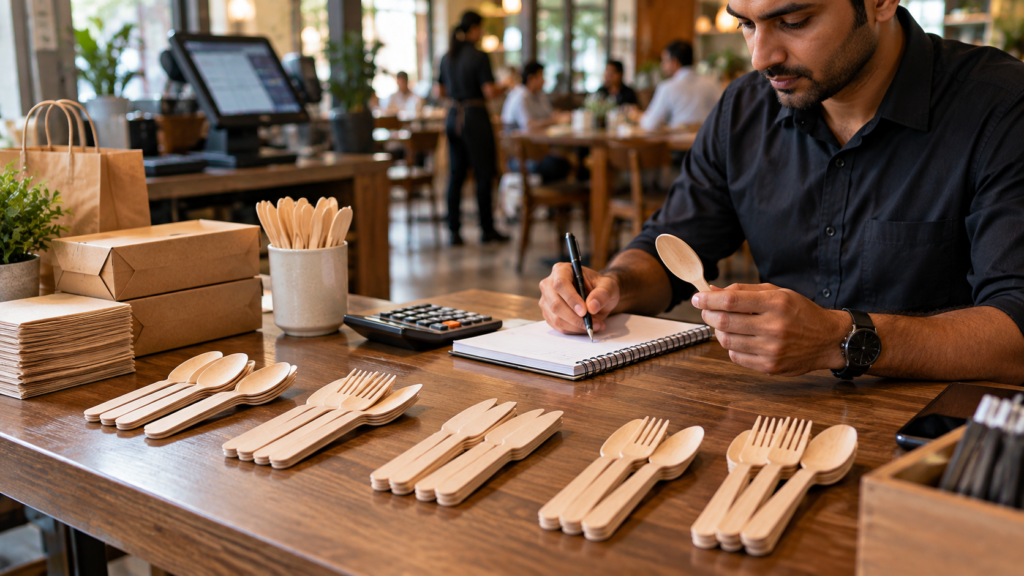
The calculation rests on four numbers: footfall, pieces per cover, a wastage buffer, and your ordering cycle. Once you have those, turning a daily count into a monthly bulk wooden cutlery order takes one multiplication.
Step 1: Track Your Average Daily Footfall
Pull covers served, not just bills, from your POS for the last 30 days. A table of four sharing one bill still uses four sets of cutlery, so billing data alone will undercount you. Split dine-in covers from takeaway and delivery orders too, because they don’t consume cutlery at the same rate — a dine-in dessert order might use one spoon, while the same dish packed for delivery usually goes out with a full set, whether the customer needed it or not.
Step 2: Decide Pieces Per Cover
Look at your actual menu rather than a generic average. A curry-and-rice cover might need only one spoon. A thali or multi-course meal might need a spoon, a fork, and a stirrer for the drink. Quick-service restaurants serving fries, burgers, and shakes typically hand out a fork and spoon per order even when only one gets used, since customers rarely return unused pieces. Plan for what you hand out, not just what gets used.
Step 3: Apply the Daily Consumption Formula
Once footfall and pieces-per-cover are set, the daily number comes from a single formula:
Daily Requirement = Average Daily Covers × Pieces per Cover × Buffer Factor (1.10–1.15)
The buffer factor covers breakage, double-packing on delivery orders, and ordinary staff error. A restaurant averaging 300 covers a day, at 1.5 pieces per cover, would need:
300 × 1.5 × 1.10 = 495 pieces per day
Step 4: Convert Daily Numbers into Weekly and Monthly Bulk Orders
Multiply the daily figure by 7 for a weekly count and by 30 for a monthly bulk wooden cutlery order. In the example above, that works out to roughly 3,465 pieces a week and close to 14,850 a month — numbers worth having ready when you approach a wooden cutlery wholesale supplier, since most quote better per-piece pricing once an order crosses certain carton thresholds.
Sample Calculation: 50-Seat Restaurant
| Metric | Value |
|---|---|
| Seating capacity | 50 seats |
| Average table turns per day | 2.5 |
| Daily covers | 125 |
| Pieces per cover | 1.5 |
| Buffer factor | 1.10 |
| Daily requirement | ≈ 207 pieces |
| Weekly requirement (× 7) | ≈ 1,447 pieces |
| Monthly requirement (× 30) | ≈ 6,200 pieces |
A 50-seat restaurant running this pattern would typically place its wooden cutlery pack orders on a monthly cycle, since 6,000+ pieces usually clears the minimum order quantity most wholesale wooden cutlery suppliers set for better rates.
Factors That Affect Wooden Spoon and Fork Consumption in Restaurants
The formula above gives a baseline. These four factors are what actually move the number up or down from month to month.
Dine-In vs Takeaway and Quick-Service Format
A full-service restaurant with washable crockery for dine-in and wooden cutlery only for takeaway will use far less than a QSR or cloud kitchen where every single order leaves in a box. If delivery makes up more than half your covers, expect your disposable wooden cutlery consumption to sit well above the sit-down-only average.
Menu Type and Course Structure
Soups, desserts, and multi-course thalis push consumption per cover higher because each course can call for its own spoon or fork. A single-dish QSR menu, by contrast, tends to stay closer to one or two pieces per order.
Seasonal and Weekend Footfall Swings
Weekend covers can run 30–50% above weekday averages in most Indian restaurants, and festival weeks or exam-result season for nearby colleges can spike delivery volumes without much warning. Building your monthly order around a 30-day average, rather than a slow weekday, keeps you from running short exactly when it matters.
Breakage, Wastage, and Buffer Stock
Wooden cutlery is sturdier than plastic but not indestructible, and cartons occasionally arrive with a few splintered or damaged pieces. The 10–15% buffer built into the formula is meant to absorb this, along with the odd delivery order that gets packed with an extra spoon by mistake.
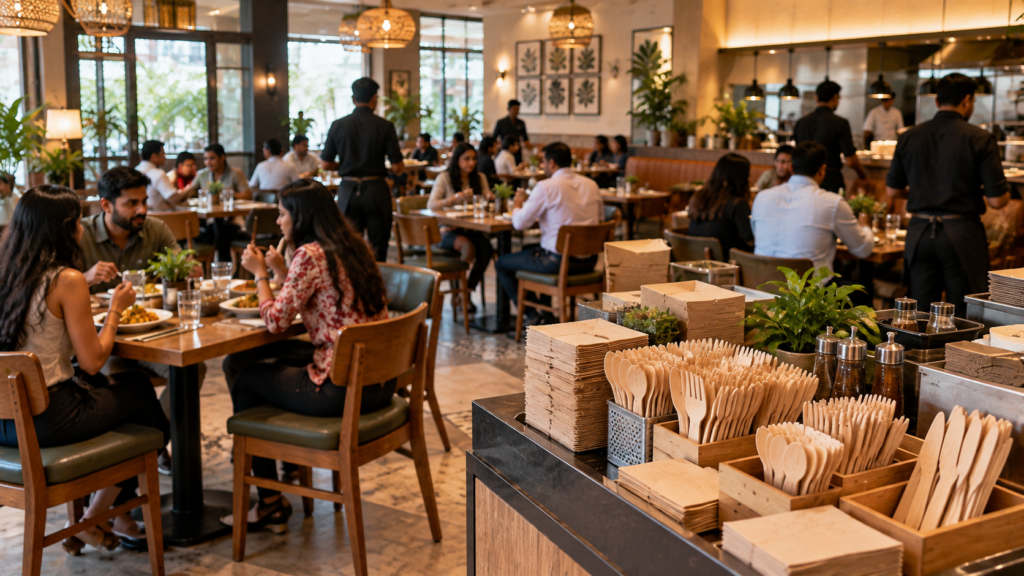
Average Wooden Cutlery Consumption Per Meal in Indian Restaurants
As a rough planning benchmark:
- Full-service dine-in: 1–2 pieces per cover (mainly desserts and soups)
- QSRs and cafes: 1.5–2 pieces per order (fork + spoon combos are common even for single items)
- Cloud kitchens and delivery-first brands: 2–3 pieces per order, since every order is packed as if for a stranger who has nothing at home
- Catering and buffet events: Often 3+ pieces per guest once serving spoons and stirrers are counted
These are starting points, not fixed rules. Track your own data for 3–4 weeks and adjust the pieces-per-cover figure in the formula to match what your restaurant actually hands out.
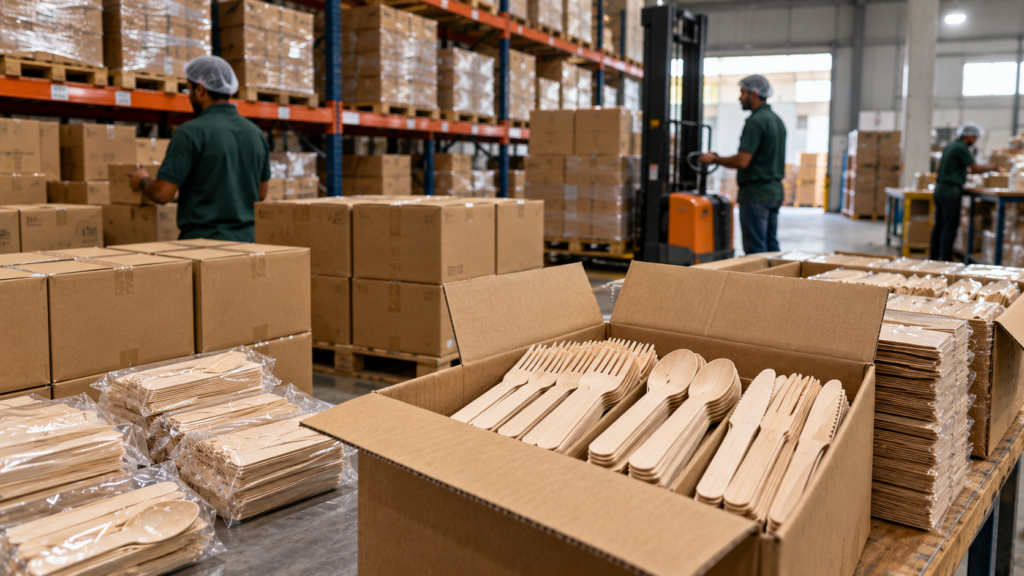
Where to Buy Bulk Wooden Cutlery for Restaurants in India
Once you know your monthly number, sourcing is straightforward. Most restaurants, cafes, and catering brands buy through one of three routes: a local packaging and disposables distributor, a dedicated wooden cutlery manufacturer selling direct, or a B2B wholesale marketplace such as IndiaMART or Tag Ingredient where multiple wooden cutlery suppliers list catalogs with minimum order quantities and per-piece pricing.
Buying direct from a manufacturer usually works out cheaper per piece once your monthly requirement crosses a few thousand units, but it often means a higher minimum order and a longer lead time than a local distributor who keeps stock on hand for same-week delivery.
What to Check Before Placing a Wholesale Order
- Wood type and finish — birch is the most common, sanded smooth enough to avoid splinters
- Food-grade certification (FSSAI compliance for anything sold or used in India)
- Moisture-sealed, tamper-evident packaging, especially for monsoon-season storage
- Minimum order quantity and whether it matches your calculated monthly need
- A sample pack before committing to a full bulk wooden cutlery order — check for splinters, warping, or an off smell
Average Cost of Wholesale Wooden Cutlery Sets
Pricing swings with wood quality, order volume, and whether pieces are sold loose or individually wrapped. As a general market range, individually wrapped wooden cutlery sets (spoon, fork, napkin) typically cost more per piece than loose bulk cartons, while very large orders — the kind a multi-outlet chain might place — usually bring the per-piece rate down further. It’s worth getting quotes from two or three wooden cutlery wholesale suppliers before committing, since pricing can vary noticeably between vendors for what is functionally the same product.
Restaurant Crockery and Cutlery Checklist (Quick Reference)
Wooden cutlery is usually just one line on a bigger restaurant crockery and cutlery list. A quick reference before you place any bulk order:
- Wooden spoons, forks, and knives (takeaway and delivery)
- Wooden stirrers for beverages
- Steel or ceramic cutlery for dine-in service
- Napkins and paper wraps to pair with each cutlery set
- Serving spoons and buffet-line utensils for catering events
Keeping this on a simple spreadsheet, alongside your calculated monthly wooden cutlery number, makes reordering far less of a fire drill.
Frequently Asked Questions
How do I estimate the quantity of wooden cutlery needed for a mid-sized restaurant in India?
Take your average daily covers from the last 30 days, multiply by your pieces-per-cover figure (usually 1.5–2), then multiply by a 1.10 buffer factor. Multiply that daily number by 30 for a monthly bulk order estimate.
How to calculate daily wooden cutlery needs for a 50-seat restaurant?
Estimate daily covers by multiplying seats by average table turns (commonly 2–3 turns a day), then apply the same formula: covers × pieces per cover × buffer factor. A 50-seat restaurant with 2.5 turns and 1.5 pieces per cover needs roughly 207 pieces a day.
What factors should I consider when calculating wooden spoon and fork requirements for a restaurant?
Footfall split between dine-in and delivery, menu type and course count, weekend or seasonal spikes, and a breakage buffer of 10–15% all affect the final number.
What factors affect wooden spoon and fork consumption in quick-service restaurants?
QSRs tend to hand out a full fork-and-spoon set per order regardless of need, so delivery share, menu simplicity, and order volume during peak hours matter more than course count.
Can you guide me on calculating wooden cutlery usage based on average customer footfall?
Yes — footfall is the starting variable. Pull covers (not bills) from your POS, apply your pieces-per-cover ratio, and add a buffer for wastage. Recalculate every 4–6 weeks as footfall shifts seasonally.
What is the formula for estimating weekly disposable wooden cutlery orders?
Weekly requirement = (Average daily covers × pieces per cover × buffer factor) × 7. This converts your daily estimate into a practical weekly reorder quantity.
Where can I find suppliers offering bulk wooden cutlery packs suitable for restaurants?
Local packaging and disposables distributors, dedicated wooden cutlery manufacturers, and B2B marketplaces like IndiaMART and TradeIndia are the three most common sourcing routes for restaurants and cafes in India.
Where can I find bulk suppliers of eco-friendly wooden cutlery in India?
Search wholesale marketplaces for compostable wooden cutlery or biodegradable wooden cutlery listings, and confirm FSSAI food-grade certification and sample quality before placing a full bulk order.
What is the average wooden cutlery consumption per meal in Indian restaurants?
Roughly 1–2 pieces per cover for dine-in, 1.5–2 for QSRs and cafes, and 2–3 for delivery-first cloud kitchens, though the exact figure depends heavily on menu type.
What are the average costs for wholesale wooden cutlery sets?
Cost depends on wood quality, individual wrapping, and order volume. Individually wrapped sets generally cost more per piece than loose bulk cartons, and large multi-outlet orders typically bring the per-piece rate down. Getting quotes from a few wooden cutlery wholesale suppliers is the most reliable way to compare.
Final Thoughts
A bulk wooden cutlery order doesn’t need to be a guess. Once you’ve tracked footfall, settled on a realistic pieces-per-cover ratio, and built in a sensible buffer, the same formula scales whether you’re running a 20-seat cafe or a five-outlet QSR chain. Recheck the numbers every couple of months, since footfall and menu changes shift the math more than most owners expect.