
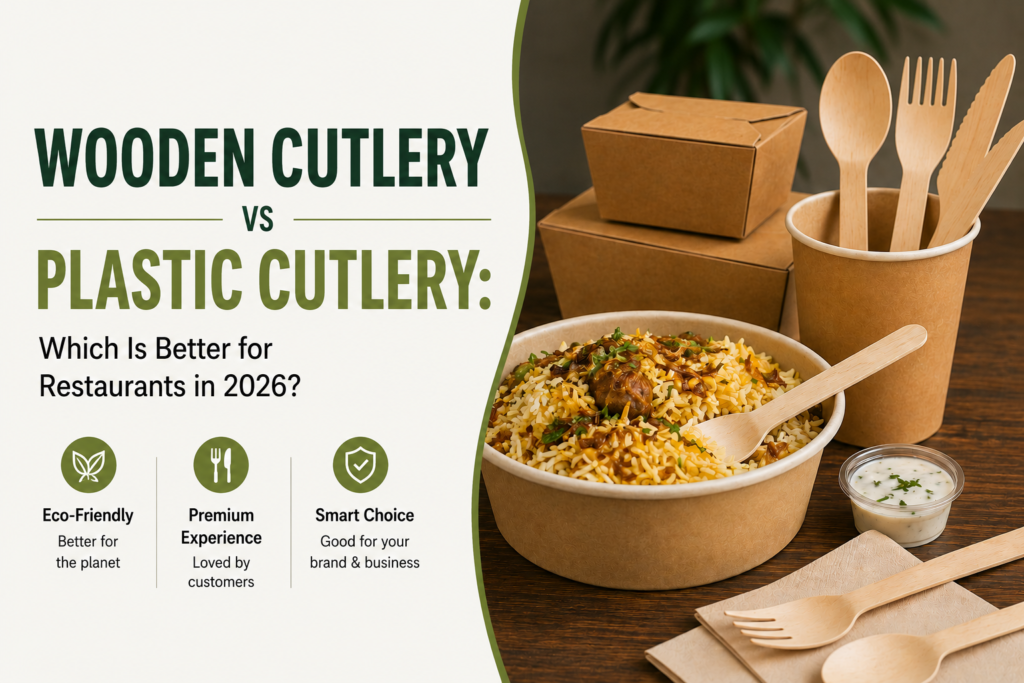
If you run a restaurant, cloud kitchen, or catering business, you’ve probably had this exact argument with your ops team at least once: do we stick with plastic spoons and forks, or switch to wooden cutlery? It sounds like a small decision, but it touches your costs, your brand image, your customer reviews, and — increasingly — your compliance with local plastic bans. So let’s actually break it down, no fluff, just what matters for a buyer trying to make the right call in 2026.
Why This Question Matters More Than Ever
A few years ago, disposable cutlery was an afterthought. You bought whatever was cheapest, packed it with the order, and moved on. That’s changed. Customers now notice what they’re eating with. A diner who gets a wooden spoon with their biryani order feels like the restaurant cares. A diner who gets a flimsy, bending plastic fork that snaps halfway through their meal? That becomes a one-star review, and those stick around.
On top of that, several Indian states and municipalities have tightened restrictions on single-use plastic cutlery, and more restaurants are getting audited or fined for using banned SUP (single-use plastic) items. So this isn’t just a taste or brand question anymore — it’s a business risk question too.
Wooden Cutlery: What You’re Actually Getting
Wooden spoons, forks, and wooden utensils for cooking or serving are usually made from birch, bamboo, or similar sustainably sourced wood. Here’s what restaurant owners actually care about:
Durability under real use. A decent wooden spoon or wooden fork holds up fine through a full meal — rice, curry, noodles, even soup. It doesn’t snap the way a cheap plastic soup spoon does under pressure. If your menu involves thicker, heavier food (think biryani, khichdi, or anything scooped rather than stirred), a sturdy wooden spoon actually performs better.
Compostability. This is the big one. Wooden cutlery breaks down naturally — most of it is genuinely compostable within a few months in the right conditions, unlike plastic, which sits in a landfill for centuries. If your restaurant is trying to market itself as eco-conscious (and a lot of Zomato/Swiggy-listed restaurants are leaning into this now), wooden cutlery is an easy, visible way to prove it.
Perceived quality. There’s a psychological effect here that’s easy to underestimate. Wooden spoons and forks feel more premium — closer to what you’d get at a sit-down restaurant than a roadside stall, even if the food itself is mid-range. That perception bump matters for takeout and delivery orders where the packaging is the first impression.
The catch: cost and sourcing. Wooden cutlery tends to run more expensive per unit than plastic, especially at scale. Bulk wooden spoons, forks, and wooden ladles from a reliable Indian supplier can cost anywhere from noticeably more to significantly more than plastic equivalents, depending on the wood quality and finish. If you’re a high-volume operation moving thousands of orders a day, that price difference adds up fast — so it’s worth actually running the math for your own order volume rather than assuming either way.
Plastic Cutlery: The Old Standard, Still Around
Plastic spoons, plastic forks, and plastic utensils are still the default for a huge chunk of the restaurant industry, and it’s not hard to see why.
It’s cheap. Bulk plastic cutlery, whether it’s disposable plastic spoons, forks, or combo packs, is usually the lowest-cost option per unit by a wide margin. For thin-margin QSRs and high-volume delivery kitchens, that cost advantage is hard to ignore.
It’s lightweight and consistent. Plastic doesn’t warp, doesn’t absorb moisture from gravies, and every piece coming out of the box looks and feels the same. There’s less variation to worry about compared to natural materials like wood.
But the downsides are catching up with it. Plastic cutlery has a genuine environmental cost — it’s the classic single-use plastic problem, and regulators are increasingly aware of it. Beyond regulation, customer sentiment is shifting. Getting a plastic fork with your order in 2026 reads, to a growing number of diners, as the restaurant not really trying. And functionally, thin plastic forks and spoons do bend, crack, or snap under real food — anyone who’s tried to eat a thick curry with a cheap plastic spoon knows the struggle.
There is a middle ground worth mentioning here: some Indian companies now offer biodegradable plastic cutlery, made from cornstarch-based or PLA materials instead of standard polypropylene. It looks and feels like regular plastic cutlery but breaks down faster and complies with newer SUP regulations. It’s a reasonable option if you want the plastic form factor without the full environmental and compliance baggage — though it typically costs more than standard plastic, and less than wooden, so it’s genuinely a middle-tier choice on price too.
Head-to-Head: Cost, Durability, and Environmental Impact
Here’s the honest comparison restaurant buyers actually ask us about:
On cost per unit, standard plastic wins by the widest margin. Biodegradable plastic sits in the middle. Wooden cutlery costs more upfront, but many restaurants find the gap shrinks once you factor in fewer customer complaints about broken utensils and the value of the eco-friendly positioning in marketing.
On durability for heavy restaurant use, wooden cutlery generally holds up better against thick, heavy food — curries, rice dishes, biryani — where a plastic spoon might bend or snap. For lighter foods like salads or desserts, plastic performs just fine and the durability gap matters less.
On environmental impact, there’s no real contest. Wooden and compostable cutlery break down naturally; standard plastic cutlery does not, and its production and disposal carry a heavier carbon and pollution footprint. This is the single biggest reason restaurants are shifting toward wood, biodegradable plastic, or edible cutlery.
On customer perception, wooden cutlery consistently reads as more premium and more trustworthy from a food-safety and care standpoint, especially for restaurants using delivery apps where packaging is the only “in-person” touchpoint with the customer.
So, Which Should You Actually Choose?
It genuinely depends on what kind of restaurant you’re running:
If you’re a premium or mid-range restaurant, a cloud kitchen trying to build a brand, or anyone marketing sustainability, wooden cutlery is worth the extra cost. It pays for itself in fewer complaints, better reviews, and a brand story that resonates with today’s customers.
If you’re a high-volume, low-margin QSR or a canteen-style operation where cost per order is the deciding factor above almost everything else, standard plastic (or biodegradable plastic, where regulation demands it) may still make more operational sense — just be aware of the regulatory direction things are heading in.
If you’re somewhere in between and want the eco-story without the full wooden-cutlery price tag, biodegradable plastic cutlery from an Indian supplier is a genuinely solid middle path.