
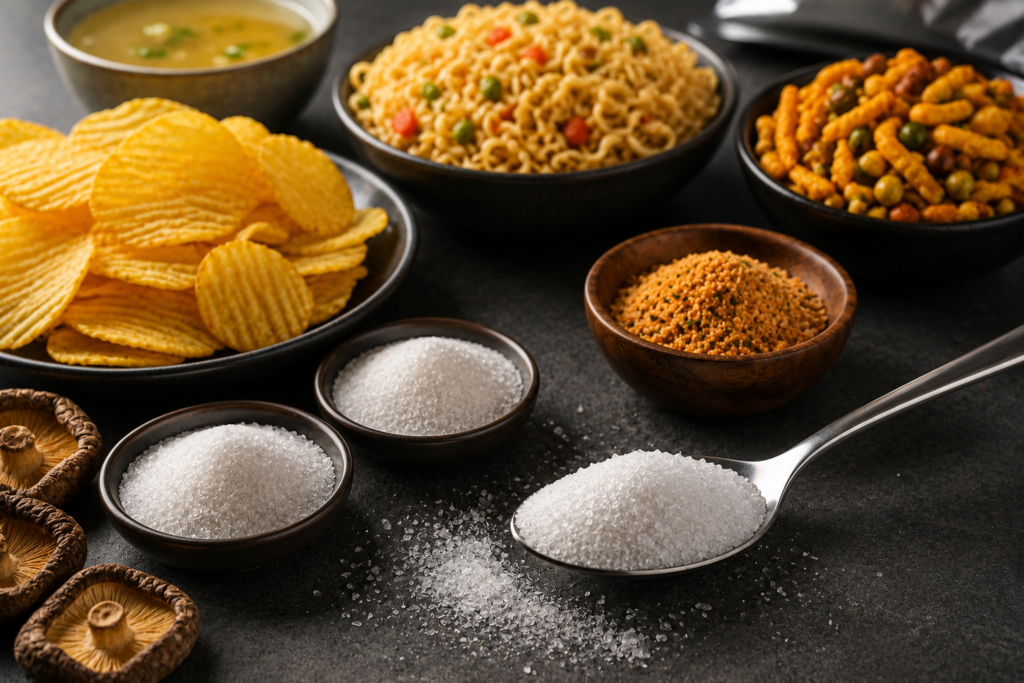
If you work in food manufacturing, you’ve probably run into the term I+G flavour enhancer while developing snacks, seasonings, instant noodles, soups, or sauces. So what is it, how does it work, and why does it show up in so many savoury formulations?
I+G helps bring out the savoury, umami side of a food’s flavour. The name usually points to two specific ingredients: disodium guanylate (INS 627) and disodium inosinate (INS 631).
What Is I+G Flavour Enhancer?
In the food industry, “I+G” is shorthand for disodium 5′-guanylate (INS 627) and disodium 5′-inosinate (INS 631) used together. Both are classified as flavour enhancers, and FSSAI lists both INS 627 and INS 631 under its food additive regulations.
I+G doesn’t add a new flavour so much as it turns up the volume on the savoury taste already in the food. That’s what makes it useful for manufacturers chasing a stronger, more balanced umami profile.
What Is Umami, Exactly?
Umami sits alongside sweet, salty, sour, and bitter as one of the five basic tastes. It’s the deep, savoury note you pick up in broths, mushrooms, meat, and most rich savoury dishes.
Consumers keep gravitating toward snacks and ready-to-eat foods with a fuller, more satisfying taste, which is part of why umami has become such a focus in product development. For manufacturers, getting that taste right often means leaning on ingredients that support it.
How Does I+G Work in Food?
I+G works by strengthening the savoury notes that are already present in a formulation, rather than introducing a new one. Disodium inosinate and disodium guanylate are particularly effective in savoury applications, and used together, they produce a stronger umami effect than either does on its own.
That combined effect is why I+G comes up so often when teams are developing snack seasonings, potato chips, namkeen, instant noodles, soups, sauces, and other processed or ready-to-eat foods. How much to use depends on the product, the formulation, local regulations, and the taste profile you’re aiming for — there’s no universal dosage.
What Is Disodium Guanylate?
Disodium guanylate (INS 627), also written as disodium 5′-guanylate, is classified by JECFA as a flavour enhancer with an ADI listed as “not specified.” In manufacturing, it’s mainly used in savoury products where the goal is a fuller overall taste.
What Is Disodium Inosinate?
Disodium inosinate (INS 631), or disodium 5′-inosinate, is also a JECFA-classified flavour enhancer with an ADI of “not specified.” It’s almost always discussed alongside disodium guanylate, since the two work together to boost umami taste.
What Is Flavour Enhancer 635?
Flavour enhancer 635 — disodium 5′-ribonucleotides — is a mixture of disodium inosine-5′-monophosphate and disodium guanosine-5′-monophosphate. In practical terms, INS 635 combines what INS 631 and INS 627 bring individually. JECFA classifies it as a flavour enhancer with an ADI of “not specified,” and FSSAI lists it the same way.
Worth noting for manufacturers: I+G and INS 635 are related but not automatically interchangeable as commercial ingredients, so it’s worth checking the exact specification before you swap one for the other.
Is Flavour Enhancer 635 Harmful?
This comes up a lot. JECFA’s database lists the ADI for INS 635 as “not specified,” but that shouldn’t be read as a green light to use it without limits. The right usage still depends on the food category, applicable regulations, formulation, and what your supplier’s specifications say.
For commercial production, check current FSSAI requirements along with the product spec, COA, and other quality documents before you commit to using any food additive.
Is Flavour Enhancer 635 Veg or Non-Veg?
You can’t answer this from the INS number alone — the vegetarian status depends on the source and how it was manufactured. If you’re building a vegetarian or vegan product, ask your supplier directly for the source of the ingredient, the manufacturing process, its vegetarian status, the product spec, relevant certificates, and COA documents. This matters even more if the product is heading to the Indian market, where vegetarian labelling gets checked closely.
Why Do Food Manufacturers Use I+G?
Consistency is usually the biggest reason. A seasoning or formulation needs to taste the same batch after batch, and I+G helps get there, especially for products that need a strong, dependable umami flavor.
That said, I+G isn’t a fix-all — it should be chosen based on the whole formulation, not just added on top when a product needs more flavour. Ingredient quality, dosage, the rest of the seasoning system, and processing conditions all factor into the final result.
Where to Buy Food-Grade I+G in India
When sourcing I+G in India, compare suppliers on quality, documentation, consistency, packaging, and how much they can actually supply. Before buying, ask for the technical specification, COA, product grade, source details, packaging options, MOQ, and regulatory paperwork.
For manufacturers running larger volumes, a dependable supplier makes a real difference in keeping raw material quality consistent across batches.
FAQs
What is I+G flavour enhancer?
I+G usually refers to disodium guanylate (INS 627) and disodium inosinate (INS 631) used together — two flavour enhancers that support savoury, umami taste.
What is flavour enhancer 631?
Flavour enhancer 631 is disodium 5′-inosinate, a food additive classified as a flavour enhancer.
What is flavour enhancer 627?
Flavour enhancer 627 is disodium 5′-guanylate, also called disodium guanylate, and it’s classified as a flavour enhancer.
What is flavour enhancer 635?
INS 635 is disodium 5′-ribonucleotides — a mixture of disodium inosinate and disodium guanylate.
Is flavour enhancer 635 harmful?
JECFA lists the ADI for INS 635 as “not specified.” Manufacturers should still follow applicable food regulations and approved usage limits rather than treating that as unrestricted.
What is umami?
Umami is the savoury, often rich or meaty taste associated with broths, mushrooms, and many savoury foods.
Where can I buy food-grade I+G?
Specialised food ingredient suppliers carry food-grade I+G. Check product specifications, COA, source, quality documents, MOQ, and regulatory compliance before buying.
Final Word
I+G flavour enhancer matters to any manufacturer working on savoury products. Ingredients like INS 627 and INS 631 support the umami side of a formulation and help round out the overall taste.
Whether you’re making snacks, seasonings, instant foods, soups, sauces, or ready-to-eat products, the ingredient quality and the supplier you choose matter just as much as the formulation itself.