
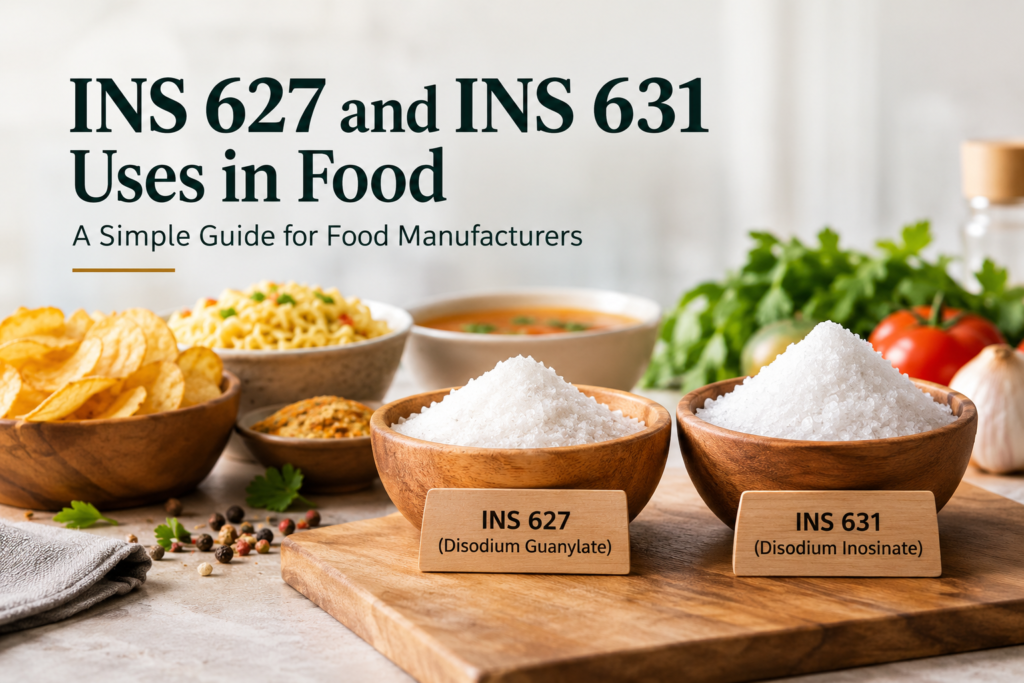
INS 627 and INS 631 are flavour enhancers used across a wide range of savoury food products. Both work on the umami side of taste, and manufacturers usually pair them with MSG (INS 621) rather than using either one alone.
If you make snacks, instant noodles, seasoning blends, soups or ready-to-eat meals, it’s worth knowing exactly where these two additives fit in a formulation and what Indian regulations say about using them.
This guide covers what INS 627 and INS 631 actually are, how they work, where they show up on ingredient lists, and what to check before sourcing them.
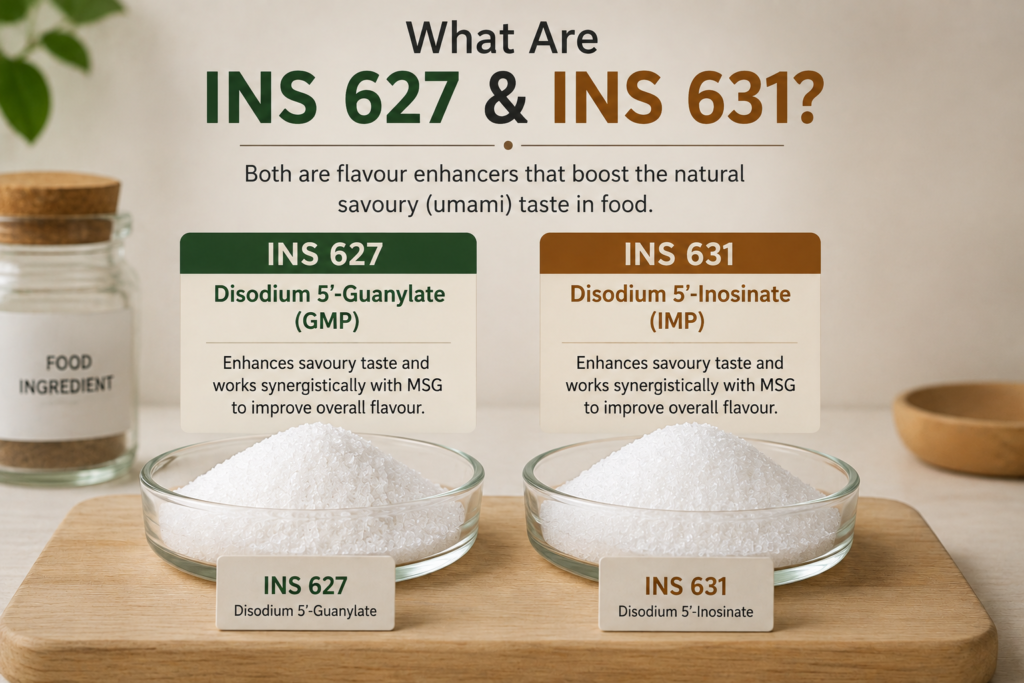
What Are INS 627 and INS 631?
INS 627 is disodium 5′-guanylate — most people in the industry just call it disodium guanylate, or GMP.
INS 631 is disodium 5′-inosinate, known more commonly as disodium inosinate, or IMP.
FSSAI classifies both as flavour enhancers, and the FAO/JECFA databases carry their technical specifications along with the Codex INS numbers. Neither one adds a new flavour of its own — instead, they make the savoury flavours already in a product taste fuller.
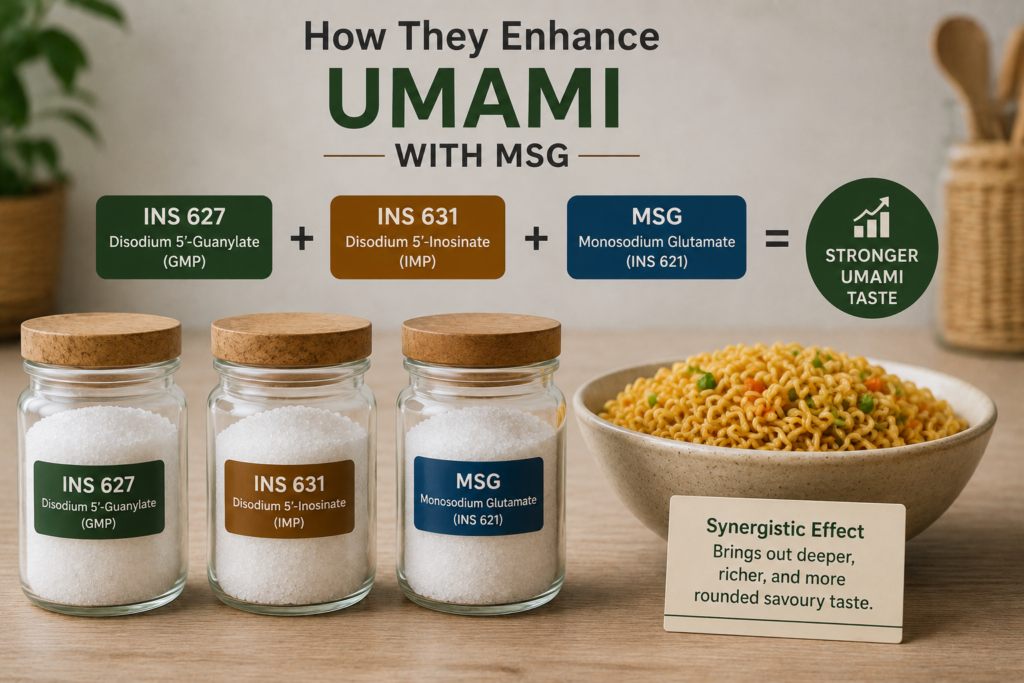
How Do INS 627 and INS 631 Enhance Food Taste?
Their main job is supporting umami. On their own they don’t do a great deal, but combined with MSG they tend to push a savoury product’s flavour up a notch and round it out.
A seasoning developer might reach for this pairing when building flavours such as:
- Masala
- Cheese
- Chicken-style
- Barbecue
- Tomato
- Mushroom
- Soup
- Savoury spice blends
How much gets used, and how, comes down to the specific product, the flavour system it’s built on, and the taste profile the manufacturer is going for.
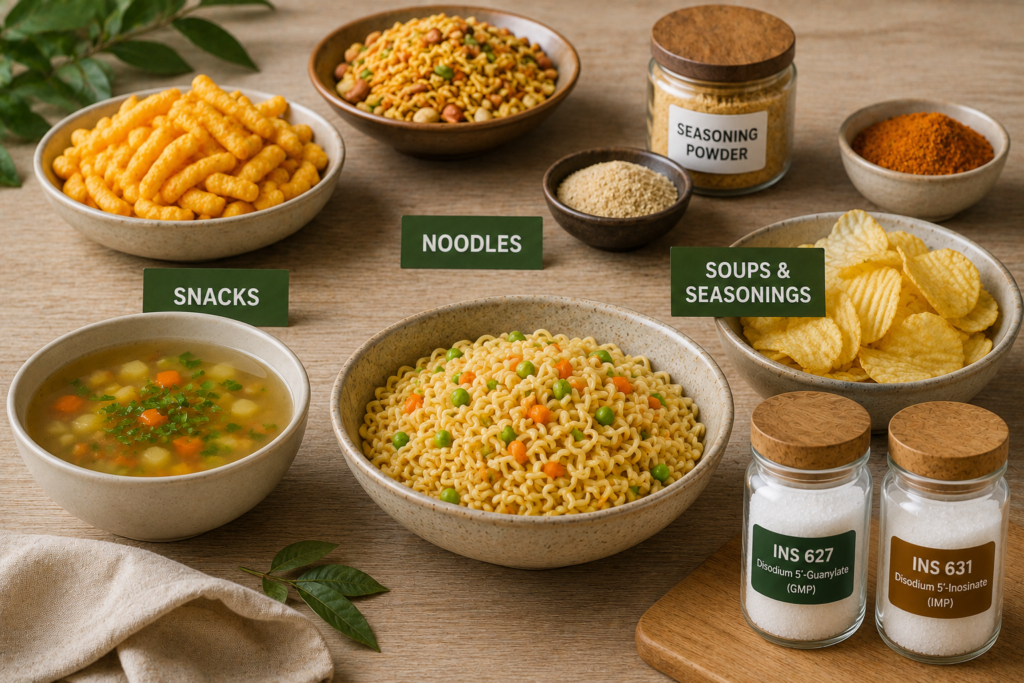
INS 627 Uses in Food
INS 627 shows up mainly in savoury processed foods, wherever a manufacturer wants a stronger flavour impact.
1. Packaged Snacks
Chips, extruded snacks, namkeen and savoury snack mixes often use INS 627 in their seasoning systems, where it helps the spice blend come through more clearly.
2. Instant Noodles
Noodle seasoning powders are one of the more common applications — INS 627 supports the deeper savoury notes manufacturers are usually chasing here.
3. Soup and Seasoning Powders
Soup mixes, stock-style products and seasoning powders can all use INS 627 to strengthen their overall savoury profile.
4. Ready-to-Eat Foods
In ready-to-eat meals and similar processed foods, INS 627 can help the flavour hold up after processing rather than fading out.
5. Processed Meat and Savoury Products
Depending on what’s permitted for the food category and how the product is formulated, flavour enhancers may also find their way into other processed savoury foods.
INS 631 Uses in Food
Like INS 627, INS 631 is a flavour enhancer, and it’s typically used alongside other umami ingredients rather than by itself. Common uses include:
- Potato chips and savoury snacks
- Namkeen and snack mixes
- Instant noodles
- Soup powders
- Seasoning blends
- Ready-to-eat meals
- Savoury processed foods
- Certain meat and fish products
The Codex GSFA database lists INS 631 as a flavour enhancer, with provisions covering several food categories — dried noodles among them, along with certain meat, fish and vegetable products.
For manufacturers, the detail that matters most is that permitted use and maximum levels vary by food category. Check the current FSSAI requirements before locking in a formulation.
INS 627 and INS 631 in Snacks and Ready-to-Eat Foods
Why do these two turn up so often in snacks specifically? Savoury snacks need a flavour that’s both strong and consistent from batch to batch.
Spices and flavour compounds do the main work of building taste, while flavour enhancers help bring out the savoury notes already there. That’s useful across products like:
- Potato chips
- Extruded snacks
- Masala snacks
- Instant noodles
- Ready-to-eat meals
- Soup mixes
- Seasoning powders
- Savoury biscuits
- Snack mixes
How well this works in practice depends on the whole recipe — salt levels, MSG, spices, flavouring substances and everything else in the mix, not just the flavour enhancer on its own.
Are INS 627 and INS 631 Safe According to Indian Food Regulations?
FSSAI lists both INS 627 and INS 631 as flavour enhancers under its product standards framework, which includes the Food Products Standards and Food Additives Regulations and their amendments.
That listing isn’t a blanket approval to use as much as you like, though. Additives still have to be used within the limits set for the specific food category — FSSAI’s regulations and appendices spell out category-by-category requirements for permitted additives.
Before commercial production, check the current FSSAI regulation for your food category and confirm the permitted level.
Are There Potential Side Effects of INS 627 and INS 631?
People searching for “INS 627 side effects” or “INS 631 side effects” are usually reacting to the fact that these additives show up in processed foods generally, not to specific evidence against them.
It’s not accurate to claim these ingredients cause health problems as a rule. JECFA — the joint FAO/WHO expert committee — carries out scientific safety evaluations of food additives, including these two, and issues guidance based on that work.
Anyone with specific dietary concerns should read the full ingredient list and, if needed, ask the manufacturer directly about where the additive comes from.
Is INS 631 Vegetarian?
This depends on the source and how it was made.
Disodium inosinate can come from fermentation, but it can also come from animal-derived raw materials depending on the supplier and process used. Because of that, manufacturers making vegetarian claims shouldn’t assume every batch of INS 631 has the same origin — that needs confirming with the supplier directly.
For Indian consumers, the vegetarian or non-vegetarian mark on the finished product label matters just as much.
What Is the Difference Between INS 627 and INS 631?
| Feature | INS 627 | INS 631 |
| Common name | Disodium guanylate | Disodium inosinate |
| INS number | 627 | 631 |
| Main function | Flavour enhancer | Flavour enhancer |
| Main taste role | Supports umami/savoury taste | Supports umami/savoury taste |
| Common use | Snacks, seasonings, processed foods | Snacks, noodles, seasonings, processed foods |
| Often paired with | MSG and INS 631 | MSG and INS 627 |
In short, both work as supporting players in a flavour system rather than as the main flavour themselves.
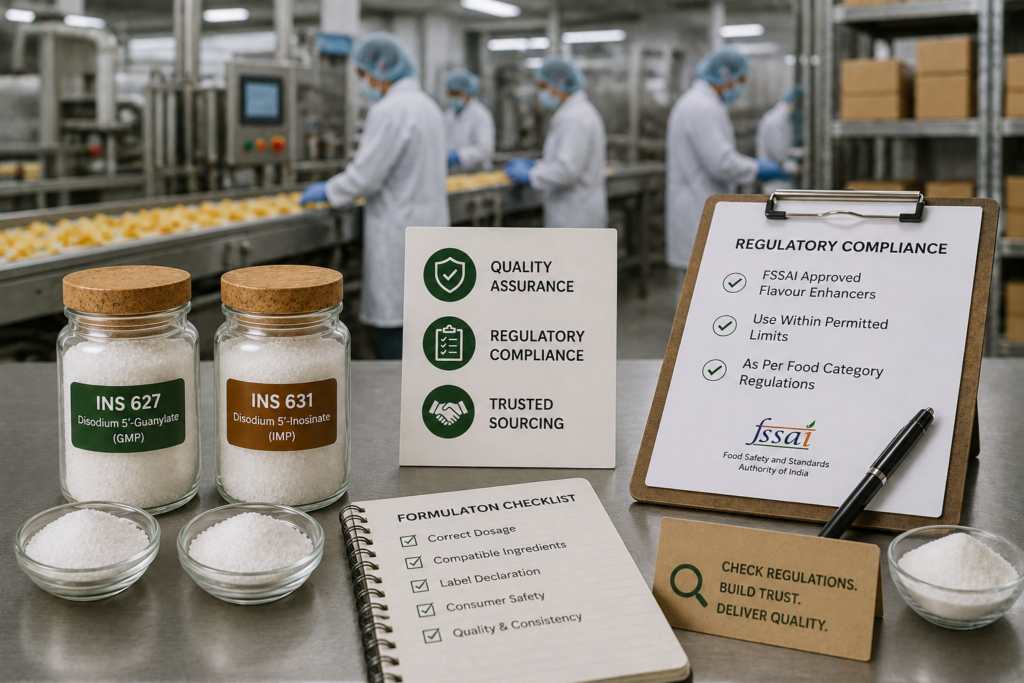
What Should Food Manufacturers Consider When Buying INS 627 and INS 631?
Before sourcing either additive, it’s worth checking a few things:
- Food-grade quality — confirm the material is suitable for food use
- Specification and purity — review the supplier’s technical spec and Certificate of Analysis
- Regulatory compliance — confirm the additive is permitted for your food category
- Source information — especially if you’re making vegetarian or other source-related claims
- Application performance — test it in the actual seasoning or food system
- Supplier consistency — steady quality keeps the taste consistent batch to batch
A supplier worth working with should be able to hand over the technical and quality documents you need for commercial production.
Frequently Asked Questions
Which food products in India commonly contain INS 627 and INS 631?
Packaged snacks, seasoning mixes, instant noodles, soups, ready-to-eat foods — the list depends on what’s permitted for each food category, but these are the usual suspects.
What are the common uses of INS 627 and INS 631 in packaged foods?
Mainly as flavour enhancers, propping up the savoury or umami taste in snacks, noodles, soups, seasonings and similar processed foods.
How do INS 627 and INS 631 enhance the taste of processed foods?
They deepen the savoury and umami side of a dish. Paired with MSG and other flavour ingredients, the result is usually a fuller, more rounded taste than either would give alone.
How do INS 627 and INS 631 improve the taste of snacks and ready-to-eat meals?
They lean on whatever spice or flavour system is already there and round it out rather than adding something new.
What types of packaged snacks in India commonly contain disodium guanylate and disodium inosinate?
Chips, extruded snacks, namkeen, snack mixes, flavoured noodle products — though the exact formulation decides what’s actually in a given product.
Where can I find snacks with INS 627 and INS 631 as flavour enhancers?
The ingredient list on the pack is the place to look. Indian labelling rules require manufacturers to declare permitted additives, and FSSAI sets out how additives and their functional classes need to be listed.
Are INS 627 and INS 631 safe for consumption according to Indian food regulations?
Yes — FSSAI recognises both as flavour enhancers under its food additive framework. That said, use still has to stay within the permitted category, conditions and levels.
What are the potential side effects of consuming foods with INS 627 and INS 631?
There’s no real basis for saying these cause side effects as a rule. It comes down to permitted use and overall exposure. Anyone with specific dietary concerns should check labels and talk to a qualified health professional.
Final Takeaway
INS 627 (disodium guanylate) and INS 631 (disodium inosinate) are flavour enhancers with a genuine role in savoury food manufacturing — they bring out the umami character in processed foods rather than creating a flavour from scratch.
For manufacturers, it’s not just a matter of picking a flavour enhancer off a supplier’s list. Quality, source, specification and application level all matter, and all of it has to sit within current FSSAI requirements.
Whether you’re building out packaged snacks, instant noodles, seasonings, soups or ready-to-eat foods, understanding how these two actually work helps you put together a flavour system that holds up batch after batch.