
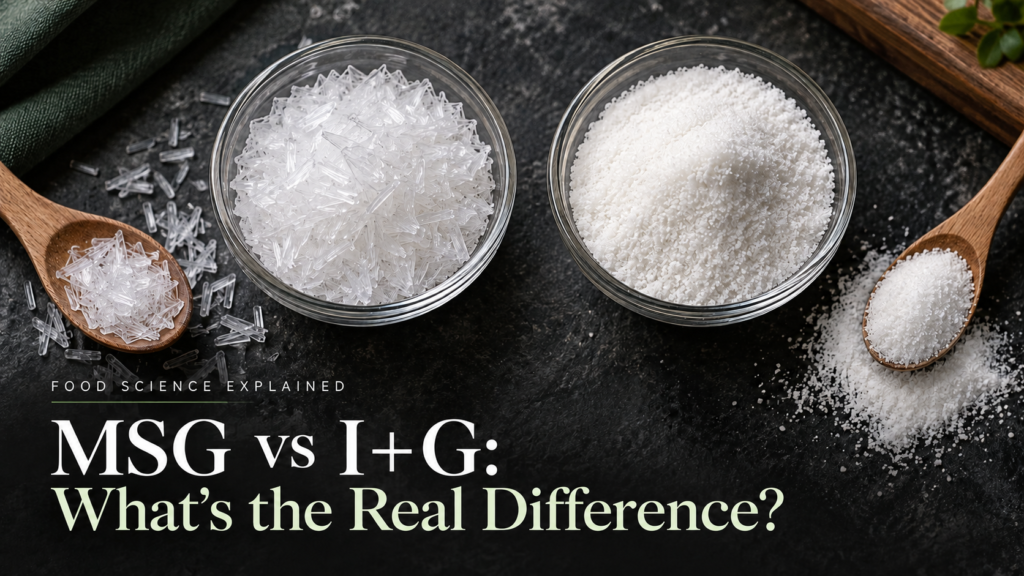
If you’ve ever flipped over a packet of instant noodles or namkeen and spotted “621” or “635” on the ingredient list, you’ve run into two of the food industry’s most common flavour boosters. Search interest in msg vs i+g has grown steadily as home cooks and small food brands try to figure out what’s actually sitting inside their masala packets. MSG, or monosodium glutamate, is the ingredient most people have heard of. I+G is the one nobody explains properly, even though it shows up in nearly the same products.
This article breaks down the msg vs i+g difference in plain language: what each ingredient is, how they behave on the tongue, whether one is genuinely safer than the other, and where to buy them, whether you cook at home or run a food business that needs a reliable msg flavour enhancer or i+g flavour enhancer supply.
What Is MSG? Understanding the Original Flavour Enhancer
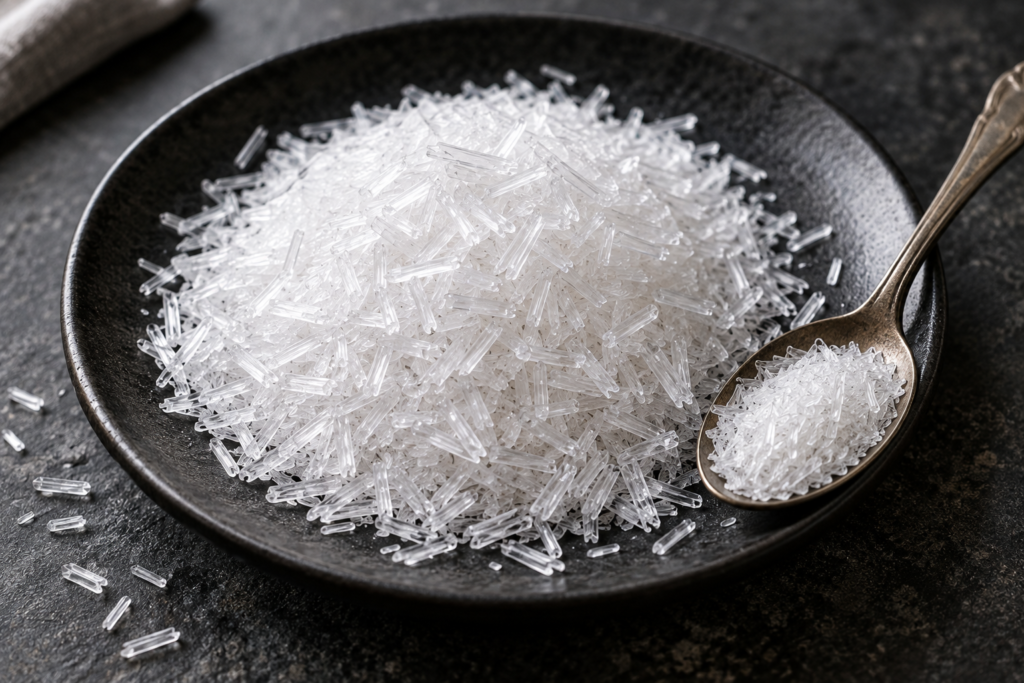
MSG stands for monosodium glutamate — the sodium salt of glutamic acid, an amino acid your body already produces and one that occurs naturally in foods like tomatoes, parmesan cheese, and mushrooms. Commercially, MSG is made by fermenting starch, sugar beet, sugar cane, or molasses, roughly the same process used to make yogurt or vinegar.
On an ingredient label, MSG usually hides behind a number: E621, or simply 621 — exactly what people are checking for when they search msg flavour enhancer number. You’ll also see it sold under recognisable brand names — Ajinomoto flavour enhancer and Accent flavour enhancer are two of the most common in Indian and international kitchens. If a recipe calls for a flavour enhancer monosodium glutamate blend, this is almost always what’s being described.
How MSG Works as a Flavour Enhancer
MSG doesn’t add flavour the way sugar adds sweetness or salt adds saltiness. Instead, it stimulates specific taste receptors on the tongue that detect umami — the savoury, meaty taste found in broths, aged cheese, and soy sauce. Added to a dish, MSG amplifies existing savoury notes rather than introducing a new one, which is why a small pinch can make a bland soup taste noticeably richer.
Where You’ll Find MSG (E621) on Ingredient Labels
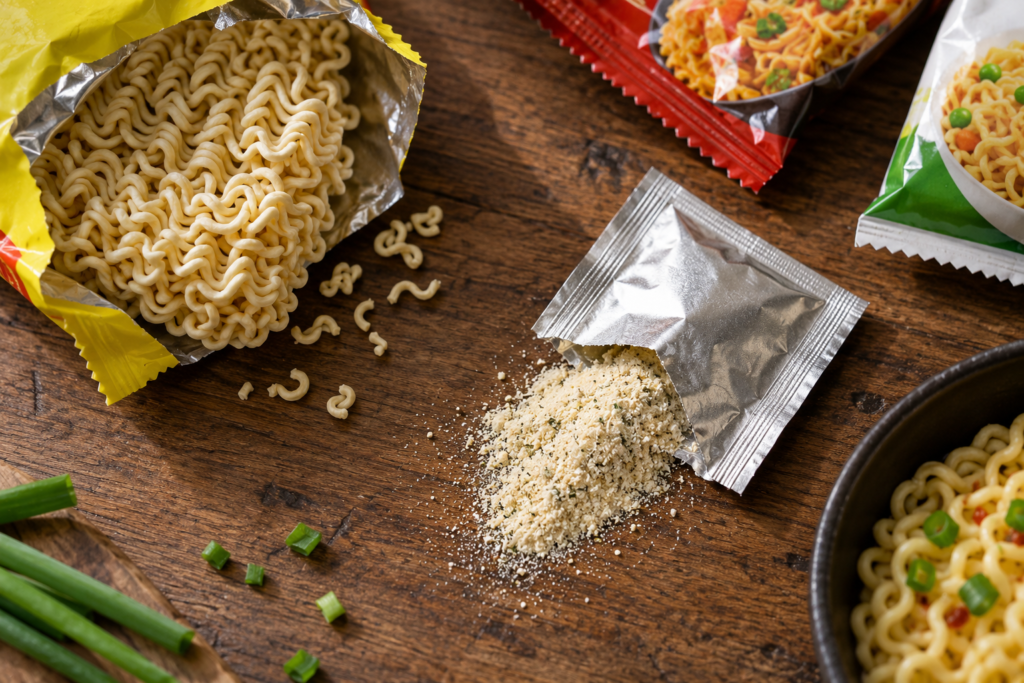
MSG turns up across a wide range of packaged foods: instant noodles, potato chips, packaged masalas, canned soups, and most chinese food flavour enhancer blends sold for home cooking. Restaurants serving Indo-Chinese cuisine have relied on it for decades, though many now advertise “No MSG” as a marketing point, whether or not the claim holds up on the actual label.
What Is I+G? The Ribonucleotide Pair Behind Modern Snacks
I+G is shorthand for a 1:1 blend of two ribonucleotides: disodium inosinate (IMP, E631) and disodium guanylate (GMP, E627). Some manufacturers label the same combination as disodium 5’-ribonucleotides, or E635 — which is why the search term flavour enhancer 635 msg gets used loosely, even though 635 technically refers to the I+G blend rather than MSG itself.
Unlike MSG, which is an amino acid derivative, I+G belongs to a completely different chemical family: nucleotides, the same class of compound that makes up DNA and RNA. This is the core of the msg vs disodium inosinate guanylate comparison — two additives that both boost umami but come from entirely different chemistry.
The Chemistry Behind I+G
IMP occurs naturally in meat, fish, and dried bonito flakes. GMP is found in shiitake mushrooms and other fungi. Commercially, both are produced through fermentation, often using a process similar to MSG production — one reason the two ingredients are so frequently packaged and sold together.
Chemically, I+G molecules bind to the same umami taste receptors as glutamate, but at a different site on the receptor. When IMP or GMP is present alongside glutamate, the receptor’s sensitivity to umami rises well beyond what either ingredient could produce on its own. Food scientists call this umami synergy.
Why I+G Is Almost Always Paired With MSG
Because of this synergy, manufacturers rarely use I+G by itself. A small amount added to a base of MSG produces a stronger umami effect than simply adding more MSG would. That’s the practical reason so many snack and seasoning brands list an msg and i+g flavour enhancer combination on their packaging instead of choosing just one.
MSG vs I+G: Key Differences Explained
Chemical Composition Compared
MSG is a single compound — the sodium salt of one amino acid. I+G is technically two compounds sold as a pre-mixed pair. This is the most basic point in the difference between msg and i g, and it explains why the two behave differently in cooking even though both get called “flavour enhancers.”
Taste Impact and Umami Boost
Used alone, MSG delivers a clean, straightforward umami lift. I+G on its own is comparatively weak — most food technologists describe its standalone contribution as mild. The real difference shows up once msg and i+g together enter the same formulation: the combination produces a stronger, rounder savoury taste than either could achieve alone, at a lower total quantity of additive. This is why many pre-mixed flavour enhancer powders sold in Indian markets already carry a small percentage of I+G blended into a mostly-MSG base.
Usage in Packaged Foods
MSG appears more often as a standalone ingredient, especially in older or budget-tier products. I+G shows up more in premium instant noodles, ready-to-eat curries, and processed meat products, where brands want a strong savoury profile without listing a large quantity of MSG — since I+G lets them use less total glutamate for a similar effect.
How MSG and I+G Affect Taste Differently in Snacks
In snack manufacturing, the choice between the two often comes down to cost and flavour target. MSG is cheaper and gives a broad, general savoury character — useful for chips, extruded snacks, and instant noodle masalas where the goal is simply “more flavour.” i+g vs msg in food becomes a more deliberate choice when a brand wants a specific meaty or broth-like taste, such as in chicken-flavoured or Manchurian-style snack seasonings, where the inosinate component reads as slightly more savoury than glutamate alone.
A flavour enhancer chinese food blend sold for home cooking often contains exactly this pairing, since Chinese and Indo-Chinese cooking styles rely heavily on layered umami. Because I+G costs more to produce than MSG, brands generally use it sparingly and combine it with MSG rather than replacing it outright.
Health Considerations: Is I+G Safer Than MSG in India?
Regulatory Status and Safety Studies
Globally, MSG has been reviewed extensively by food safety bodies including the FSSAI, the US FDA, and the European Food Safety Authority (EFSA), all of which classify it as safe for general consumption at typical dietary levels. I+G (E631 and E627) has similarly been approved for use in packaged foods across most major food safety jurisdictions, including India, where both fall under permitted food additive categories.
Neither ingredient has been shown in controlled scientific studies to reliably cause the reactions historically blamed on “MSG symptom complex” — a set of symptoms some people report after eating MSG-containing food, which large double-blind studies have generally failed to reproduce consistently.
What This Means for Indian Consumers
For most people, both MSG and I+G are considered safe within normal dietary use. Individuals who are sensitive to either ingredient — a small minority, based on available research — may still choose to avoid packaged foods containing high levels of either. If you’re specifically looking for a msg alternative flavour enhancer for health or personal reasons, it’s worth knowing that I+G isn’t a “safer swap” in the way it’s sometimes marketed; it’s a different additive with its own separate approval, not a health-focused replacement for MSG.
Which Food Categories and Companies Use MSG vs I+G?
Snacks, Namkeens and Instant Noodles
Most Indian snack brands use some form of msg food flavouring in their masala mixes, either as standalone MSG or blended with I+G. Instant noodle brands frequently list “flavour enhancers (627, 631, 635)” on their tastemaker sachets — this is I+G, sometimes combined with a small amount of MSG for cost efficiency. This pairing is also common in packaged foods sold as a flavour enhancer in chinese food style masala.
Restaurant and Chinese Cuisine
Indo-Chinese restaurants and street food vendors have traditionally leaned on a chinese flavour enhancer — usually MSG, sold loose as an e621 food enhancer or enhancer 621 — far more than I+G, partly because MSG is cheaper and easier to buy in bulk, while I+G tends to be used more by packaged food manufacturers with access to formulated seasoning blends.
Where to Buy MSG and I+G Flavour Enhancers
Buying I+G for Home Cooking
For home cooks, small retail quantities of i+g flavour enhancer and MSG are both available through spice shops, online grocery platforms, and specialty stores that stock Chinese and Indo-Chinese cooking supplies. It’s also worth checking loose packs sold as enhancer e621 or food enhancer 621 — look for FSSAI-licensed packaging and a clear E-number declaration (627, 631, or 635) on the label before buying.
Sourcing I+G for Food Manufacturing — Choosing the Right Supplier
Food businesses formulating snacks, noodles, sauces, or ready-to-eat products need a different sourcing approach than a home cook picking up a small packet. For a bulk ingredient like this, supplier quality affects consistency, shelf life, and compliance across every batch produced.
| Sourcing I+G (Disodium Inosinate + Disodium Guanylate) for Your Product LineWhen evaluating a manufacturer or supplier for bulk I+G or a combined MSG–I+G blend, check for:A valid FSSAI food business license, and ISO 22000 or HACCP certification where applicableA current Certificate of Analysis (CoA) confirming purity and the exact IMP:GMP ratioConsistent particle size and solubility across batches, especially for dry seasoning useSample availability before committing to bulk order quantitiesTraceable sourcing with clear country-of-origin documentationWorking with a certified, quality-focused supplier for this tag ingredient protects both product consistency and regulatory compliance — two things that matter more for flavour enhancers than for almost any other food additive category, given how closely permitted usage levels are monitored. |
Frequently Asked Questions
What is the key difference between MSG and I+G in food products?
MSG is a single compound (monosodium glutamate) that delivers umami taste on its own. I+G is a 1:1 blend of two ribonucleotides — disodium inosinate and disodium guanylate — that has a much weaker effect alone but dramatically strengthens MSG’s umami taste when combined with it. For food manufacturers, I+G is increasingly treated as a tag ingredient worth sourcing separately from a verified supplier rather than buying pre-mixed with MSG.
What is the main chemical distinction between these two flavour enhancers?
MSG is derived from glutamic acid, an amino acid. I+G is made from nucleotides — inosinate and guanylate — chemical compounds unrelated to amino acids, though both are produced industrially through fermentation.
How do MSG and I+G affect taste differently in snacks?
MSG gives a broad, general savoury boost, while I+G contributes a more specific, meaty or broth-like note. In snack manufacturing, I+G is usually added in small amounts alongside MSG rather than used by itself.
How do these flavour boosters affect taste perception differently in food?
MSG activates umami taste receptors directly and consistently. I+G binds to a different part of the same receptors and mainly works by amplifying MSG’s effect — so its impact on taste depends heavily on whether glutamate is also present.
Which companies use MSG versus I+G in their packaged foods?
Budget snack and street-food seasoning tends to rely more heavily on plain MSG, while premium instant noodle brands, ready-to-eat curries, and processed meat products more often use I+G, either alone or blended into an MSG–I+G combination.
Are there health considerations for consuming either of these food additives?
Both are approved as safe for general consumption by food safety authorities including the FSSAI. A small number of individuals report sensitivity to either ingredient, though large controlled studies haven’t consistently reproduced the symptoms historically associated with MSG.
Is I+G safer than MSG for consumption in India?
Not according to current regulatory evidence — both are approved food additives in India with their own permitted usage limits. I+G isn’t classified as a “safer” substitute; it’s simply a different type of flavour enhancer.
Which common processed food categories use each of these specific ingredients?
MSG shows up widely in chips, extruded snacks, and traditional masala blends. I+G appears more often in instant noodle tastemakers, canned soups, sauces, and processed meat seasoning.
Where can I buy snacks with I+G instead of MSG nearby?
Check the ingredient panel on premium instant noodle brands, ready-to-eat meal packets, and processed meat snacks at any well-stocked supermarket — these are more likely to list 627, 631, or 635 rather than plain MSG.
Where can I buy food-grade flavour enhancing powders for home cooking?
Specialty spice shops, online grocery platforms, and Chinese/Indo-Chinese ingredient stores typically stock both MSG and I+G in small retail packs, usually labelled by their E-numbers.
Where can food businesses buy I+G in bulk for manufacturing?
For manufacturing, I+G should be sourced as a tag ingredient directly from an FSSAI-licensed supplier or manufacturer rather than a retail pack — request a Certificate of Analysis and a sample batch before ordering in bulk to confirm purity and the IMP:GMP ratio.
People Also Search For
I+G in food: A general term for the disodium inosinate + disodium guanylate blend used as a flavour enhancer in packaged foods.
MSG vs disodium guanylate: Disodium guanylate (GMP) is one half of I+G; on its own it’s weaker than MSG but stronger when the two are combined.
MSG with I+G: The most common real-world combination — most “flavour enhancer” blends on the market contain both.
Is disodium guanylate as bad as MSG: Both are approved food additives; neither has strong evidence of harm at normal dietary levels.
Is disodium guanylate MSG: No — disodium guanylate (E627) is a nucleotide, while MSG is derived from an amino acid. They’re different compounds.
I+G flavour enhancer: The retail and industrial name for the disodium inosinate/guanylate blend, sometimes labelled E635.
Is disodium inosinate and disodium guanylate bad for you: Regulatory bodies including the FSSAI classify both as safe within permitted usage limits.
What is I+G: Shorthand for a 1:1 mix of disodium inosinate (E631) and disodium guanylate (E627), used to boost umami taste.