
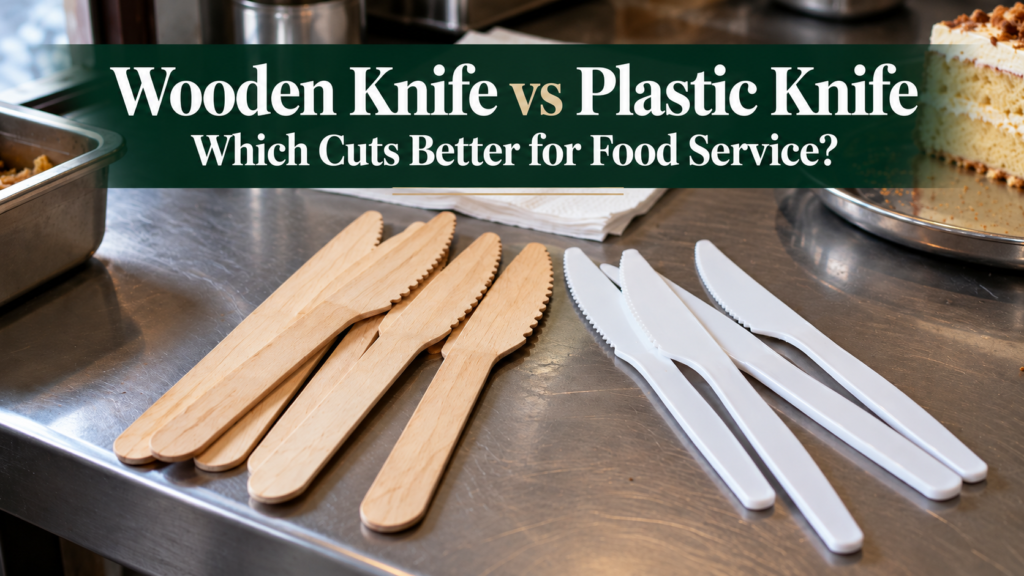
Disposable wooden knives and plastic knives sit side by side in almost every cafe, bakery and catering kitchen, yet many owners choose one without ever testing either. The choice matters more than it looks. A knife that bends under a roasted potato frustrates the customer, and a knife that splinters can lead to a complaint.
So which one cuts better? For most food service work, wooden knives cut better because the blade stays stiff. Plastic has a thinner edge and often a lower price, but it flexes on anything firm. This guide compares both on cutting strength, food type, safety, cost and Indian rules, then shows where to buy in bulk.
Table of Contents
1. Which Knife Cuts Better in Food Service?
2. What Are Disposable Wooden Knives and Plastic Knives?
3. Where Are Wooden Knives and Plastic Knives Used in Food Service?
4. How Do Wooden Knives and Plastic Knives Cut?
5. Wooden Knife vs Plastic Knife: Side-by-Side Comparison
6. What Are the Advantages of Plastic Knives Over Wooden Knives in Catering?
7. Why More Food Businesses Are Switching to Disposable Wooden Knives
8. How to Choose Disposable Wooden Knives for Your Menu
9. Where to Buy Disposable Wooden Knives in Bulk
10. Frequently Asked Questions
11. Which Knife Should You Choose?
Which Knife Cuts Better in Food Service?
Wooden knives cut better on soft and medium foods such as cake, sandwiches, paneer, fruit and cooked vegetables. They do not bend, so the force of your hand goes into the food. Plastic knives can slice thin or soft items, but they flex and sometimes snap on firm pieces. In India, plastic cutlery is also on the banned single-use list, which makes disposable wooden knives the practical choice for most food businesses.
What Are Disposable Wooden Knives and Plastic Knives?
Disposable wooden knives are single-use knives shaped from thin wood, usually birch. The wood is cut into a flat blade, often with a ridged or lightly serrated edge, and then smoothed so the surface feels clean in the hand. Food businesses buy them in bulk packs and hand them out with takeaway orders, catering trays and counter service. Buyers also search for them as single use wooden cutlery or wooden takeaway cutlery.
What Are Wooden Knives Made Of?
Birch is a common choice because it has a fine grain, a light colour and almost no smell. That matters for food, since a strong wood smell can change how a dish tastes. Uncoated wooden knives are also biodegradable wooden knives, and many buyers describe the same product as compostable wooden cutlery. If you want that benefit, ask the supplier whether any coating or wax has been applied.
What Are Plastic Knives Made Of?
Plastic knives are usually moulded from polystyrene or polypropylene. Moulding makes it easy to add fine serrations and to produce thousands of identical pieces. The downside is that the same thin, light shape that keeps the cost low also makes the knife flex. Plastic does not break down in a compost bin, so a used knife either goes to general waste or stays in the environment.
Where Are Wooden Knives and Plastic Knives Used in Food Service?
Both knives end up in the same places, but they suit different foods. Disposable wooden knives work well in bakeries and cake shops, cafes serving sandwiches and wraps, cloud kitchens, catering orders and food trucks. They also suit buffet and salad counters, where customers cut fruit, paneer, boiled eggs or cooked vegetables on a plate.
Plastic knives are common at large events, tray meals and fast food counters where the price per piece is watched closely. In India they have become hard to supply because of the plastic cutlery ban covered later in this guide.
How Do Wooden Knives and Plastic Knives Cut?
A disposable knife is not sharp like a steel blade. It cuts by pressure and a small sawing motion. That means stiffness decides almost everything.
Why Blade Stiffness Matters More Than Sharpness
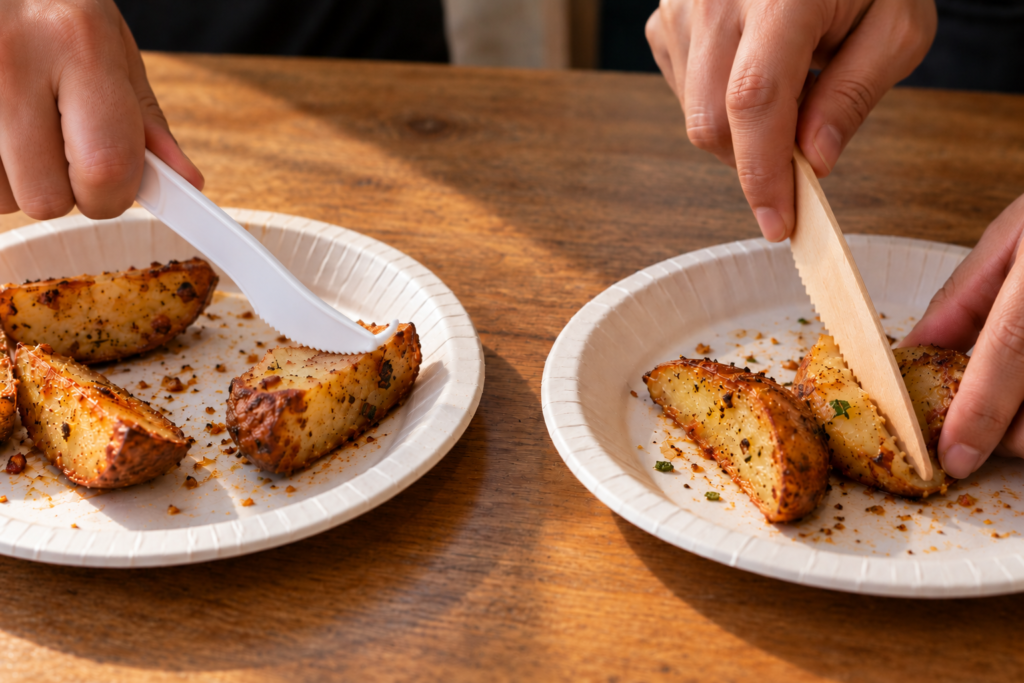
When you press a stiff blade into food, all the force goes into the cut. When you press a flexible blade, part of the force bends the blade instead. Wooden knives are rigid by nature, even when thin. Plastic knives bend, and the thinner the plastic, the sooner it gives up. Anyone who has watched a customer fold a plastic knife in half over a piece of roasted potato has seen this happen.
Cutting Soft Foods
On soft food, both knives do the job. Cake, soft bread, idli, boiled eggs, ripe fruit and cheese need very little force. A plastic knife with fine serrations can feel smoother here, while a wooden knife with a ridged edge pushes through with a light sawing action. The difference is small.
Cutting Cooked Vegetables and Firm Foods
Firm food is where the gap opens. Grilled paneer, baked brinjal, pumpkin, roasted potatoes and sweet potato chunks all have a soft inside and a firmer outside. A wooden knife holds its shape and cuts through the surface. A plastic knife tends to bend, slip off the skin or crack along a thin section.
Best Disposable Knife for Cooked Vegetables in a Food Truck
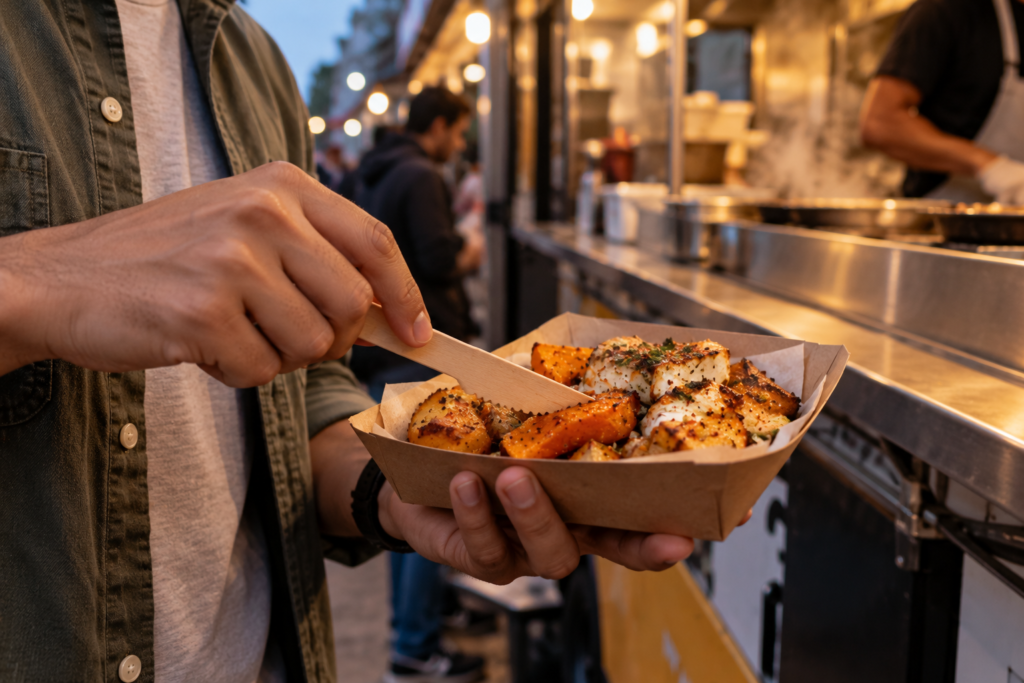
Food truck customers often eat standing up, with a tray in one hand and a knife in the other. They have little space and little patience. For cooked vegetables, disposable wooden knives are the better pick because they stay rigid when the customer has no table to brace against. Choose a knife with a smooth finish and a slightly longer handle so it feels steady.
Where Both Knives Struggle
Neither knife is meant for tough meat, large steaks or crusty bread. If your menu includes these, cut the portion in the kitchen before it leaves, or serve a reusable steel knife for dine-in orders. A disposable knife works best when the food is already portioned.
Wooden Knife vs Plastic Knife: Side-by-Side Comparison
The table below compares the two knives on the points that matter most to a food business.
| Factor | Wooden knives | Plastic knives |
|---|---|---|
| Blade stiffness | Stays rigid and does not flex | Flexes, and can bend or snap on firm food |
| Edge | Ridged or lightly serrated, cuts with a sawing action | Thin, finely serrated edge |
| Hot food | Does not soften | Thin pieces can soften in very hot food |
| Wet or saucy food | Can absorb moisture if left sitting for a long time | Waterproof and keeps its shape |
| Surface | Smooth when well finished, but a poor finish may splinter | Smooth moulded surface |
| Disposal | Biodegradable when uncoated | Does not compost |
| Price per piece | Depends on volume and supplier | Often lower |
| Rules in India | Not on the banned plastic list | Plastic cutlery banned since 1 July 2022 |
Plastic wins on moisture and often on price. Wood wins on stiffness and disposal. Which factor matters more depends on what you serve.
What Are the Advantages of Plastic Knives Over Wooden Knives in Catering?
Plastic knives do have real strengths, and a fair comparison should say so.
- They usually cost less per piece, because thin moulded plastic is cheap to produce in very large numbers. This matters at big events.
- They resist water. A plastic knife does not soften when it sits in gravy, curd or a wet salad.
- Moulding allows a thin, evenly serrated edge that works well on very soft food such as sponge cake.
- Every piece has the same shape, and there is no grain to worry about.
The trade-offs are flexing on firm food, no composting and the legal position in India. In markets where plastic cutlery is still allowed, plastic can make sense for light, soft menus. For firm food, wood is the safer bet.
Why More Food Businesses Are Switching to Disposable Wooden Knives
The biggest reason in India is the law. From 1 July 2022, the government banned the manufacture, sale and use of identified single-use plastic items, and plastic forks, spoons and knives are on that list. You can read a summary in this Down To Earth report on the ban. Rules can differ by state and may change, so check with your local pollution control board before placing a large order.
Customers also notice what comes in the bag. A wooden knife looks more natural than plastic, and it sits easily next to paper boxes and the wooden forks and spoons many cafes and cloud kitchens already use. Eco friendly disposable knives are also easy for a customer to understand at a glance.
There is a practical side too. Wood does not soften with hot food, and it carries none of the shiny, cheap look of plastic. Many suppliers sell wooden knives and forks disposable in matching sizes, so you can reorder the whole set in one go.
How to Choose Disposable Wooden Knives for Your Menu
Not every wooden knife performs the same. Use these steps before you place a bulk order.
- List the foods that need cutting. Soft cake needs less strength than roasted vegetables, so match the knife to your hardest item.
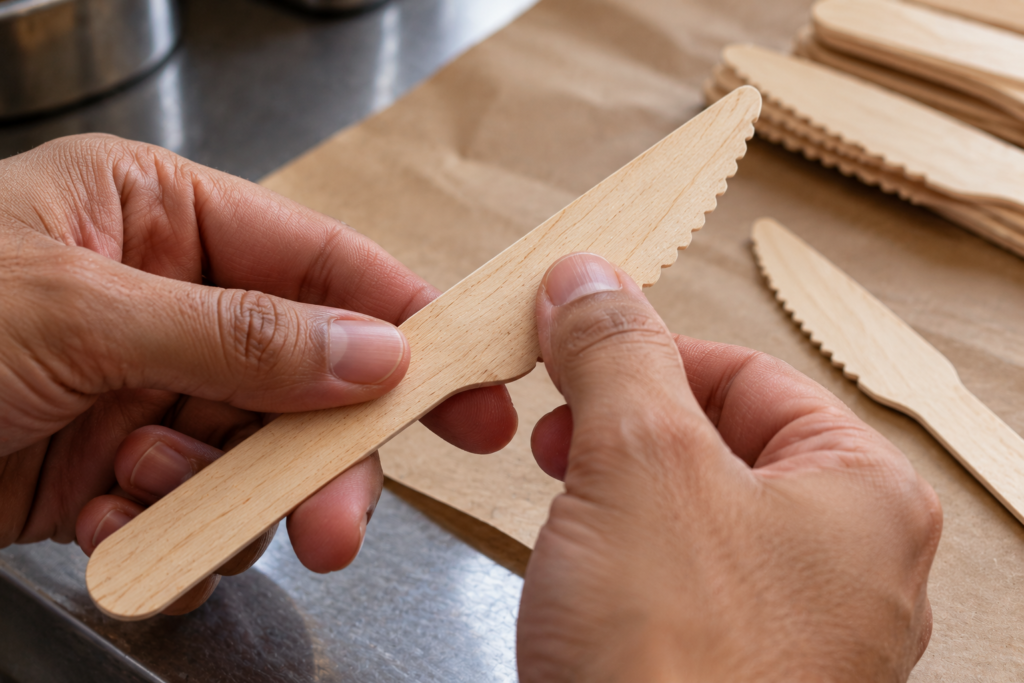
- Check the finish. Run a finger along the blade. The surface should feel smooth, with no loose fibres or sharp splinters.
- Check thickness and length. A very thin knife can crack on firm food, and the length should suit your box or container so the customer does not struggle in a deep tub.
- Test samples. Cut a cooked potato, a paneer cube and a slice of cake. Reject any knife that bends, cracks or tears the food.
- Decide on packing. Loose bulk packs suit counters, while wrapped sets suit delivery orders.
Also confirm that the wood is uncoated if you want compostable wooden cutlery. Ask for the wood name, because birch wood cutlery behaves differently from softer woods that split more easily.
Where to Buy Disposable Wooden Knives in Bulk
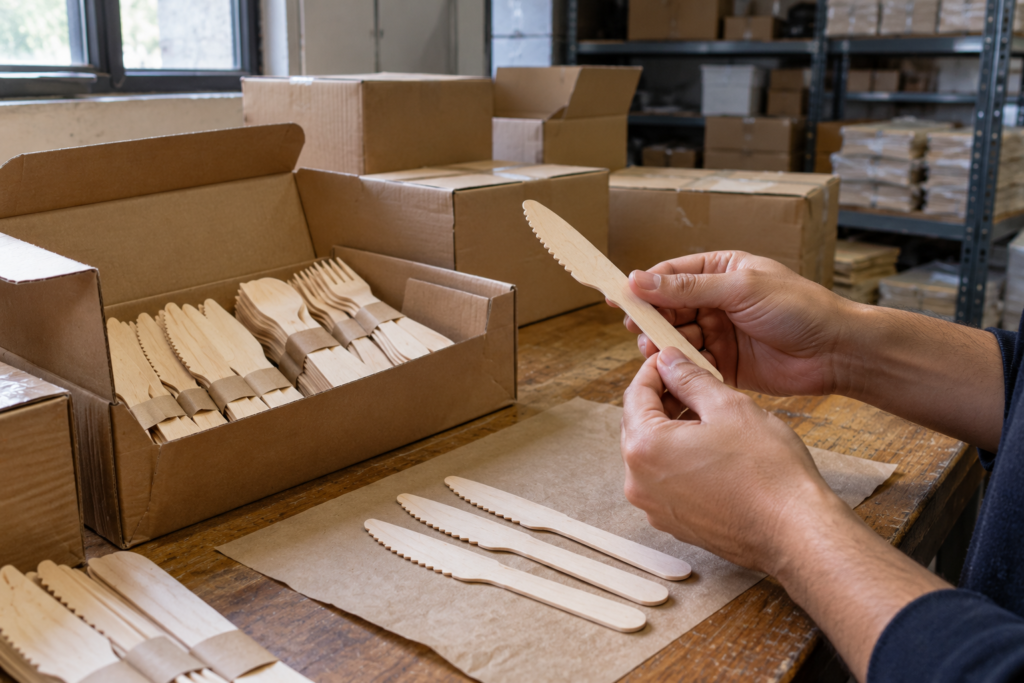
Food businesses usually buy from a wooden knife manufacturer, a wholesale supplier or a trader. A manufacturer or direct supplier can give a better price at volume and a steadier supply. A trader may be faster for small orders. Whichever you choose, ask for samples first.
Buy Wooden Knives from Tag Ingredients
If you run a cafe, bakery, cloud kitchen, catering unit or food truck, Tag Ingredients is a good place to start. Tag Ingredients supplies wooden cutlery and disposable products to food businesses in India, so you can source wooden knives along with forks and spoons from one place. Visit tagingredients.com to ask about samples, pack sizes and bulk pricing.
What to Ask Any Wooden Cutlery Supplier
Whether you buy from Tag Ingredients or compare other wooden cutlery suppliers, put the same questions to each one.
- Which wood is used, and is it coated?
- What lengths and thicknesses are available?
- What is the price per thousand pieces at your volume?
- What are the minimum order and delivery time?
- Can samples be sent before the order?
When you compare rates, ask for disposable wooden cutlery wholesale pricing rather than retail pack prices. Wooden cutlery bulk orders are usually priced per thousand pieces, and the rate often drops as the quantity grows.
Frequently Asked Questions
Which type of knife is better for food service, wooden or plastic?
For most food service work, wooden knives are better. They stay stiff, cut through cooked vegetables and firm items without bending, and are biodegradable when uncoated. Plastic knives are cheaper and water resistant, but they flex and are banned as single-use cutlery in India. Pick wood for any menu that includes firm or mixed foods.
Which disposable knife material cuts food most effectively for catering?
Wood cuts most effectively on typical catering menus because the blade does not flex under pressure. Cake, sandwiches, paneer, fruit and cooked vegetables all cut cleanly with well-finished disposable wooden knives. Plastic can match wood on very soft food, but it loses ground as soon as the food gets firmer. Neither material suits tough meat unless it is portioned first.
What are the advantages of using plastic knives over wooden knives in catering?
Plastic knives are usually cheaper per piece, resist moisture and have a fine serrated edge that suits very soft food. They keep their shape in sauces and curd, and every piece looks the same. These benefits come with limits. Plastic bends on firm food, does not compost, and plastic cutlery is banned in India as a single-use item.
Best disposable knife for cutting cooked vegetables in a food truck?
Disposable wooden knives are the best choice. Cooked vegetables such as roasted potato, pumpkin and baked brinjal have a firm outer layer, and a rigid wooden blade cuts through it without folding. Pick a smooth, uncoated knife of medium length so customers can use it comfortably while standing.
Which Knife Should You Choose?
Match the knife to your hardest food. If your menu has anything firmer than sponge cake, a wooden knife will cut it more reliably than plastic, and it keeps you on the right side of India’s single-use plastic rules. Test samples on your own dishes before buying in bulk. When you are ready to order disposable wooden knives for your cafe, kitchen or food truck, Tag Ingredients can supply them.