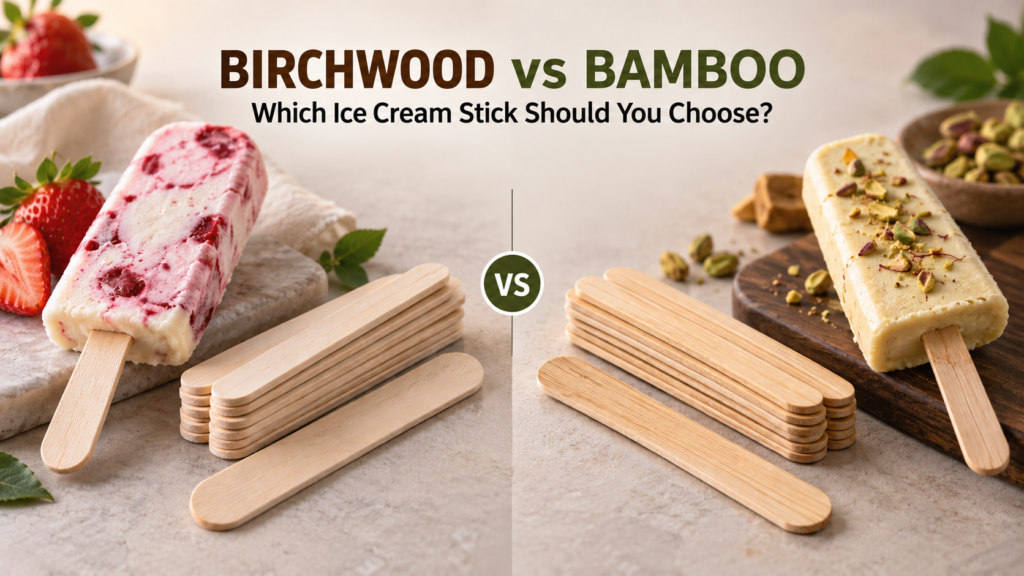
If you make ice cream, kulfi, or any frozen dessert, the stick isn’t an afterthought. It’s usually the first thing a customer’s hand touches, and it quietly becomes part of how they experience the product. In India, two materials come up again and again: birchwood ice cream sticks and bamboo ice cream sticks.
For a brand buying at scale, the decision runs deeper than the name on the label or the price per thousand. Surface finish, exact dimensions, strength, how the stick handles moisture, whether it’s food-safe, how consistent it is batch to batch, and what it actually costs once freight and rejections are factored in — all of that matters more than which wood it came from. This guide walks through the real differences and explains why birchwood tends to be the better fit for premium, standardized, B2B frozen-dessert work.
If you’re sourcing in bulk, TAG Ingredients offers a direct B2B route for birchwood ice cream sticks — specs, samples, and ongoing supply, all handled without a middleman.
Quick Answer
For most commercial ice cream, kulfi, and frozen-dessert work, birchwood is the safer all-round pick when what you need is a smooth food-contact surface, dimensions that don’t drift order to order, easy handling on the line, and a natural, premium look. Bamboo has its place too, especially for buyers who specifically want a bamboo-sourced product or need certain round-stick formats.
Either way, the material should be chosen after you’ve checked food-contact suitability, finish, exact dimensions, splinter risk, packaging, and supply consistency — not because a listing says “eco-friendly.”
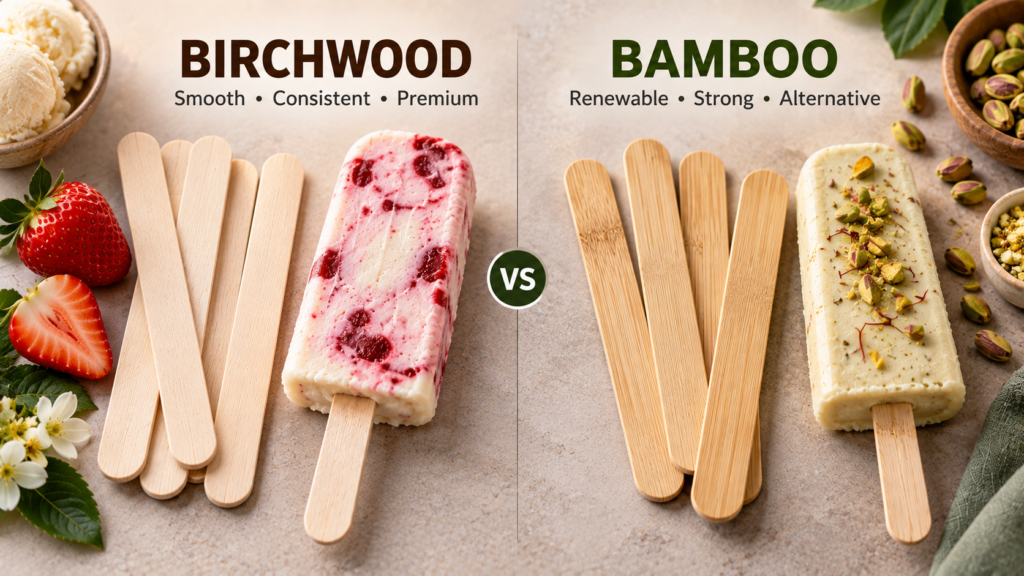
Birchwood vs Bamboo Ice Cream Sticks: At a Glance
| Buying Factor | Birchwood | Bamboo | Best Fit |
|---|---|---|---|
| Surface & Handling | Smooth, flat, comfortable to hold once properly finished | Can be smooth and strong, but finish varies by supplier | Birchwood for flat ice cream bars |
| Dimensional Consistency | Suits standardized flat-stick production well | Comes in flat and round formats, with specs that vary more | Depends on your equipment and format |
| Strength | Strong for common ice-cream-stick uses when correctly specified | Strong too, especially in the right formats | Comes down to the application |
| Food-Contact Suitability | Fine once you insist on food-grade, properly finished sticks | Same — food-grade and properly finished is what matters | Both qualify when specified correctly |
| Sustainability Story | Natural wood, renewable and biodegradable | Fast-growing renewable grass, strong sustainability angle | Depends on sourcing and processing |
| Commercial Availability | Well established for flat ice cream sticks in India | A growing but smaller range of options | Birchwood for established flat-stick sourcing |
| B2B Procurement | Strong for standardized bulk supply | Good where bamboo is a strategic choice | Birchwood for buyers who prioritize consistency |
What Are Birchwood Ice Cream Sticks?
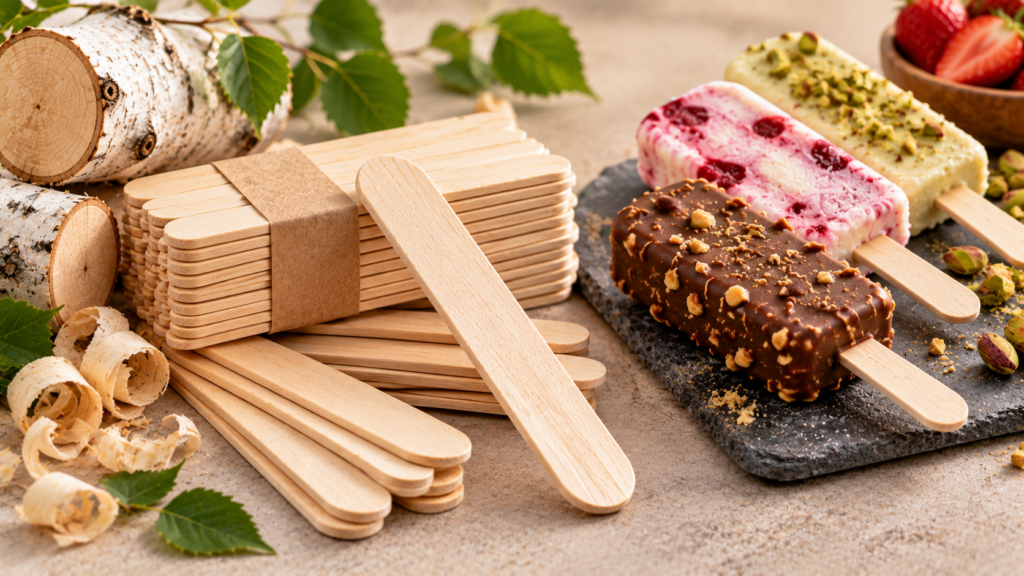
Birchwood ice cream sticks are flat wooden sticks cut from birch timber and finished for frozen desserts. For a commercial buyer, the wood species itself isn’t really the point — what matters is whether the finished stick meets your requirements on dimensions, smoothness, edge finish, moisture control, cleanliness, packaging, and food safety.
Birch is popular for flat sticks because it processes into a clean, uniform shape that suits packaged ice creams, popsicles, and similar frozen treats. That said, don’t assume every wooden stick is the same — ask any supplier for specifications and quality documentation before you commit.
Why Birchwood Works Well for Ice Cream Brands
- Gives you a consistent flat-stick format for most frozen-dessert uses
- Has a natural look that suits both premium and traditional branding
- Balances rigidity, comfortable handling, and machinability when specified correctly
- Easy to source in standardized bulk from established B2B suppliers
- A good fit for brands trying to cut down on plastic in their disposable components
What Are Bamboo Ice Cream Sticks?
Bamboo ice cream sticks are made from processed bamboo and come in flat or round formats. Indian suppliers sell them for kulfi, ice cream, lollipops, and similar food uses, though specifications can shift from one supplier to the next — so it’s worth comparing length, width or diameter, thickness, edge finish, moisture level, packaging, and minimum order quantity before you buy.
Where Bamboo Can Make Sense
- Round kulfi sticks or other specialty formats
- Brands leaning on a bamboo-specific sustainability story
- Production lines where a supplier already has a bamboo spec validated and ready
- Buyers open to qualifying a new stick format in exchange for a renewable-material alternative
How Do Birchwood and Bamboo Ice Cream Sticks Compare?
1. Strength and Rigidity
Both hold up fine when manufactured properly. Which one performs better for you depends on the weight of your product, the stick’s dimensions, how it’s inserted, storage conditions, and how it’s handled downstream. For a standard flat ice cream bar, a well-finished birchwood stick tends to be the practical choice simply because it’s so widely available in standardized flat formats.
2. Smoothness and Splinter Control
Smooth finishing isn’t optional for anything touching food. Ask your supplier directly how they finish edges and surfaces, and whether they check for visible defects before shipping. Don’t pick a stick just because it’s “wood” or “bamboo” — pick the finished, food-grade product in front of you.
3. Consistency for B2B Production
Large-scale ice cream manufacturing needs predictable dimensions, because sticks get fed into molds, filling lines, wrapping stations, or automated handling equipment. When length, width, thickness, and straightness stay consistent, you get fewer production interruptions — one more reason birchwood tends to win out for brands buying standardized flat sticks.
4. Sustainability
Bamboo gets promoted for how fast it grows, while birchwood can point to being a renewable, natural, biodegradable material in its own right. Either way, sustainability isn’t just about the raw material name — sourcing, processing, transport, packaging, and end-of-life all factor in.
For a procurement team, a documented, traceable supply chain and a clear product spec are worth more than a vague “green” claim on a listing.
5. Price and Total Procurement Cost
The cheapest unit price rarely equals the cheapest real cost. Weigh the stick price against MOQ, freight, packaging, rejection rate, breakage, dimensional consistency, and how reliably the supplier delivers.
Ask for a quote based on your actual size, quantity, and delivery location — comparing two different pack sizes or specs side by side will give you a misleading number.
6. Supply and Scalability
A national ice cream brand needs supply that holds up across multiple production cycles, not just one good batch. Your supplier should be able to tell you, clearly, what sizes and pack quantities they carry, their lead times, how they check quality, what documentation they provide, and how fast they can restock. If you want a straightforward flat-stick solution, birchwood is usually the easier one to standardize around.
What Should Ice Cream Brands Check Before Buying?
- Exact length, width, and thickness
- Flat or round construction
- Edge rounding and surface smoothness
- Food-contact suitability and the documentation that backs it up
- Moisture and storage requirements
- Pack size, carton quantity, and MOQ
- A sampling and approval process before any large order
- Lead time, delivery coverage, and how fast they can replenish stock
- Pricing based on your actual monthly or annual volume, not a sample-size quote
- Whether they can hold the same specification order after order
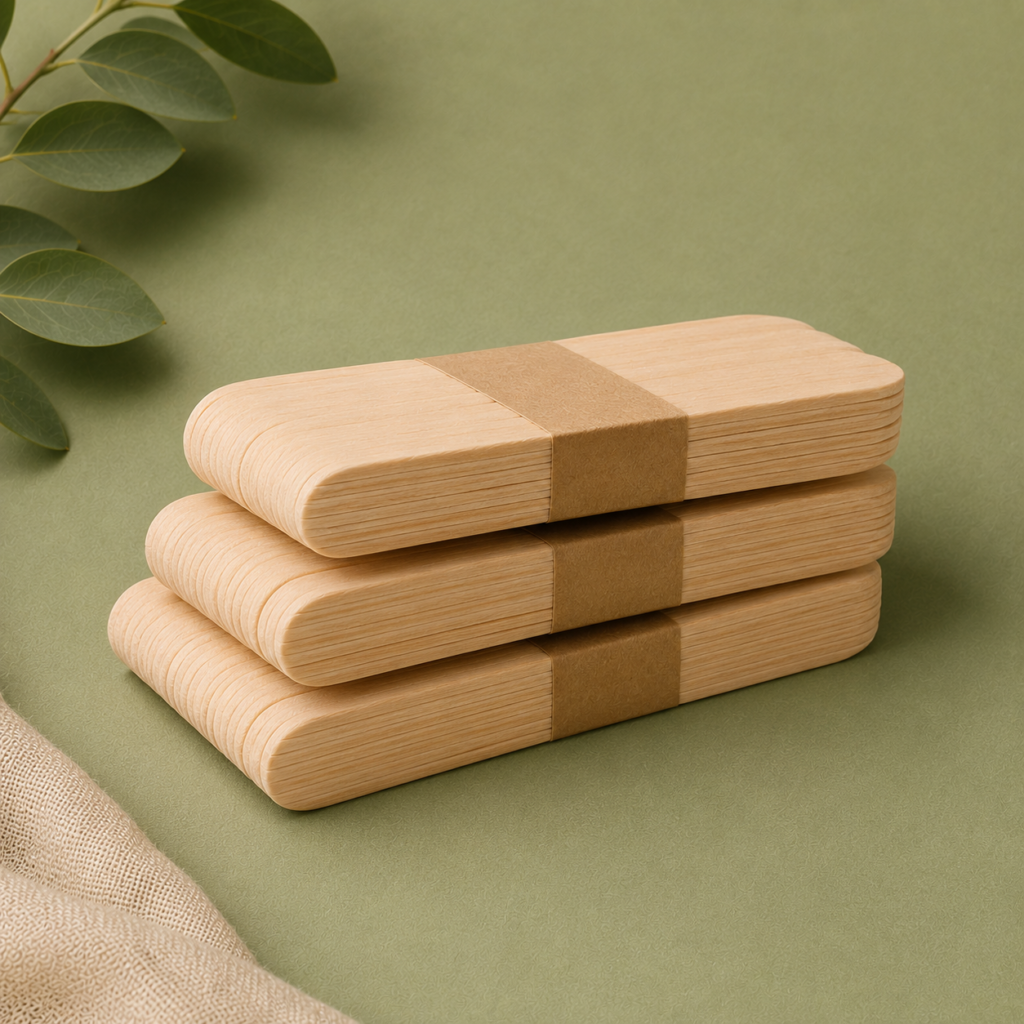
Why TAG Ingredients Is a Strong B2B Option for Birchwood Ice Cream Sticks
If you’re buying birchwood ice cream sticks in bulk and want a supplier that actually understands food-industry requirements, TAG Ingredients is worth a look. They carry food-grade birchwood ice cream sticks as part of their eco-disposables range and work with business customers across food and hospitality.
The process is straightforward: talk through your stick specification, quantity, and delivery schedule with the TAG Ingredients team, request samples where it makes sense, run the stick through your own production line, then move to a recurring supply arrangement.
If you need a dependable source for birchwood ice cream sticks, TAG Ingredients can be approached directly for B2B orders, bulk quantities, and spec discussions. Don’t pick a supplier purely on a “lowest price” claim — the better call is the one who delivers the quality you need, consistently, at the scale you need it.
Where to Buy Birchwood Ice Cream Sticks in India
You can source birchwood ice cream sticks from specialist packaging suppliers, food-industry distributors, and manufacturers directly. TAG Ingredients is one solid B2B option if you’re after natural birchwood sticks specifically.
For a direct B2B enquiry, reach out to TAG Ingredients with the size you need, your estimated monthly quantity, the application, your delivery city, preferred packaging, and whether you’d like samples first. That gives them what they need to put together a proper commercial quote.
Prices, MOQs, and stock availability shift over time, so always ask for a current quote before placing an order.
How to Choose the Right Ice Cream Stick for Your Business
Step 1: Define Your Product
A lightweight popsicle, a premium ice cream bar, and a traditional kulfi can all need different stick dimensions. Start from the finished product, not the stick material.
Step 2: Define the Stick Specification
Nail down length, width, thickness, shape, and edge finish. If you’re already using a stick, send your current sample or a technical drawing straight to the supplier.
Step 3: Run a Production Trial
Test how it inserts, freezes, demolds, wraps, and feels in a customer’s hand. This step matters even more when you’re switching materials or suppliers.
Step 4: Compare Total Cost
Look at price per piece alongside freight, MOQ, wastage, rejection rate, and delivery reliability. That gives you a far more realistic cost per finished unit than the sticker price alone.
Step 5: Lock the Specification
Once a stick passes your production test, document the approved size, finish, packaging, and acceptable quality range. It makes every reorder after that one a lot simpler.
Birchwood vs Bamboo: Which One Should You Choose?
Go with birchwood if you want a standardized flat ice cream stick, consistent handling, easy B2B availability, and a natural, premium look. Go with bamboo if your product specifically calls for it — a round kulfi format, say — or if your sustainability strategy is built around bamboo and your supplier can actually meet your production spec.
For most brands weighing the two for standard flat ice cream bars, birchwood is the sensible starting point. But the final call should come from a sample test and a real supplier quote, not just a material name on a spec sheet.
Recommended Choice for Indian Ice Cream Businesses
For Indian ice cream, kulfi, and frozen-dessert brands buying flat sticks in bulk, TAG Ingredients is a quality-focused B2B option worth talking to. You can go straight to their team to work through specifications, quantities, sampling, and commercial terms.
Frequently Asked Questions
Which birchwood ice cream stick brands are available in India?
Several Indian sellers and B2B suppliers offer birchwood ice cream sticks, and TAG Ingredients is one of them, supplying natural birchwood sticks to business buyers. Rather than choosing by seller name alone, compare the actual material, dimensions, finish, food-use suitability, MOQ, quality consistency, and supply terms.
Are bamboo ice cream sticks better for the environment than birchwood ones?
Not automatically. Bamboo has a genuine renewable-material edge, but birchwood is also a natural wood product with its own case to make. A fair comparison looks at sourcing, processing, transport, packaging, and end-of-life together, not the material name alone. For most brands, the “greener” choice is really whichever product meets your food-contact and production needs while coming from a supplier that sources responsibly.
Where can I buy birchwood ice cream sticks online in India?
TAG Ingredients lists food-grade birchwood ice cream sticks on its website and through its B2B marketplace presence. You can contact them directly for current stock, specifications, bulk pricing, and delivery terms. Since marketplace prices and MOQs change, it’s worth getting a fresh quote before you order.
Compare prices of birchwood vs bamboo ice cream sticks from Indian suppliers.
Prices shift depending on size, thickness, finish, order quantity, packaging, source, and delivery location. The comparison that actually matters is price per usable, approved stick delivered to your factory door. Ask suppliers for current quotes using identical dimensions and quality specs so you’re comparing like for like.
What companies manufacture bamboo ice cream sticks in India?
A number of Indian suppliers currently market bamboo ice cream and kulfi sticks. Before you commit, check their capabilities, product range, and manufacturing claims against your own food-contact, size, quality, and volume requirements — don’t take a listing at face value.
Final Takeaway
Birchwood and bamboo are both perfectly usable materials for frozen-dessert sticks, but the right one depends on your application and what your business actually needs from a supplier. For standard flat ice cream sticks, birchwood offers a solid mix of consistent format, easy handling, a natural look, and reliable B2B availability.
For brands and ice cream businesses in India, the next move is simple: settle on your size and monthly quantity, request a sample, run it through production, and compare total delivered cost. If you’re looking to buy birchwood ice cream sticks in bulk, get in touch with TAG Ingredients directly to talk through your requirement and get a proper spec and quote.