
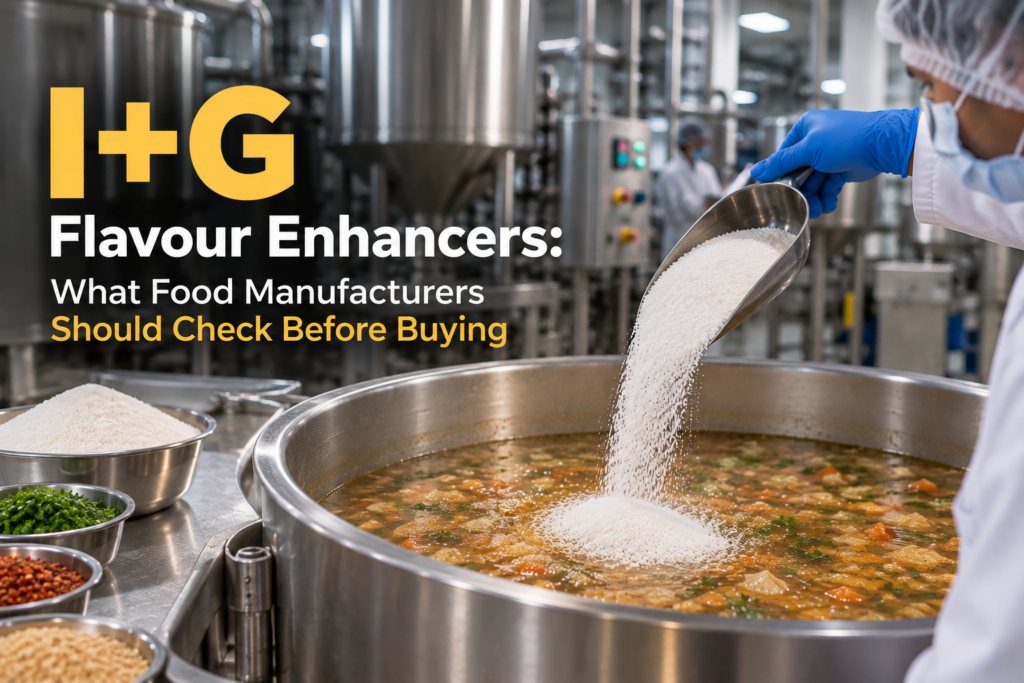
Picking an I+G flavour enhancer isn’t really about finding the cheapest price per kilogram. It has to deliver consistent umami, work well within the rest of the formulation, meet food-grade and regulatory requirements, and hold up batch after batch.
That consistency matters most in products like instant noodles, savoury snacks, seasonings, soups, sauces, ready-to-eat foods, and other processed foods, where flavour drift shows up fast.
I+G usually refers to disodium 5′-inosinate (INS 631) and disodium 5′-guanylate (INS 627). FSSAI lists both as flavour enhancers, along with disodium 5′-ribonucleotides (INS 635).
Before buying I+G in bulk, here’s what your R&D, procurement, and quality teams should look into.
What Is I+G Flavour Enhancer?

I+G is an industry term for a combination of disodium inosinate and disodium guanylate:
- Disodium 5′-inosinate — INS 631
- Disodium 5′-guanylate — INS 627
Together, they strengthen the savoury or umami character of food.
Umami is often called the fifth basic taste, alongside sweet, sour, salty, and bitter — the deep, savoury note people associate with broths, cooked meat, mushrooms, stocks, and some fermented foods.
I+G isn’t a flavour in the way chilli, cheese, or chicken flavour are. Its job is to support and strengthen the overall savoury profile that’s already there.
How Does an I+G Flavour Enhancer Work in Food?
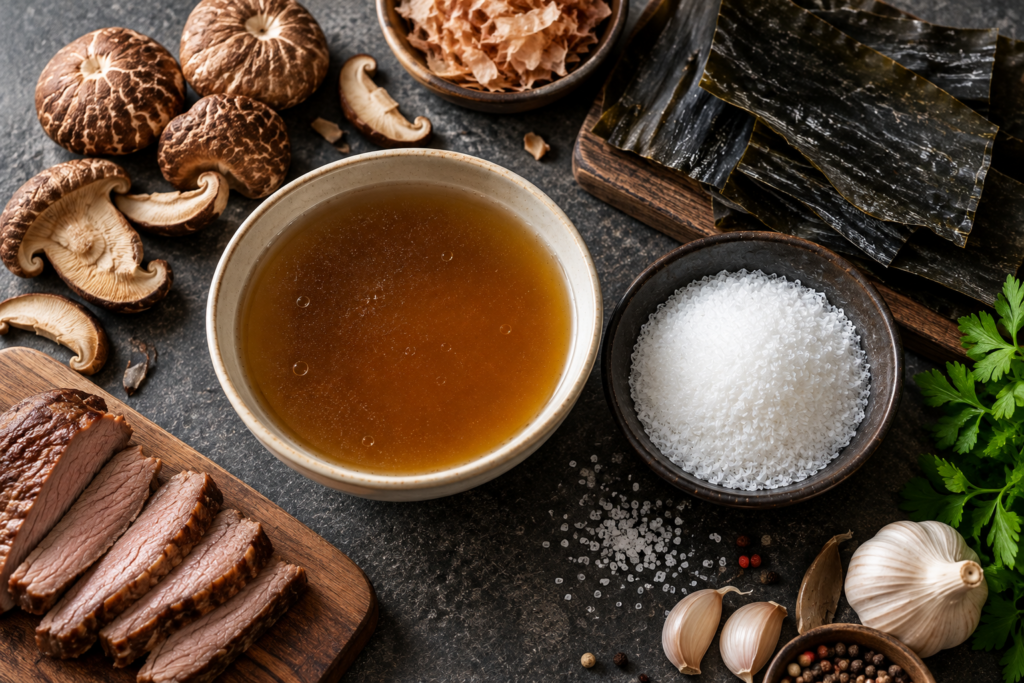
I+G works especially well when a formulation already contains glutamates — MSG, or naturally occurring glutamate from yeast extracts, hydrolysed vegetable protein, and other savoury raw materials. Put the two together, and the umami perception can come through stronger than either ingredient manages alone.
That’s why manufacturers reach for I+G when they want more savoury depth, a broth-like character, fullness, umami impact, flavour persistence, or better overall taste balance.
But more flavour enhancer doesn’t automatically mean better flavour. The result depends on the whole formulation, the processing conditions, and the taste you’re actually targeting.
7 Things Food Manufacturers Should Check Before Buying I+G
Check the Exact Composition
What’s actually in the I+G product? Ask the supplier for the technical specification rather than relying on the product name alone.
A typical I+G product contains disodium inosinate and disodium guanylate, sometimes in roughly equal proportions — though specifications vary by supplier and product. Check the IMP percentage, GMP percentage, total assay, moisture, pH, heavy metals, microbiological limits, appearance, solubility, and storage conditions. That gives your technical team a clear picture of what you’re actually buying.
Check the Grade and Food Safety Documentation
For commercial food production, the product needs to suit the intended application. Ask the supplier for a Technical Data Sheet (TDS), Certificate of Analysis (COA), Safety Data Sheet (SDS) where applicable, food-grade declaration, allergen statement, Halal or Kosher certificate if required, non-GMO statement where relevant, country of origin, batch information, and any relevant certifications.
Don’t treat this as paperwork that only quality cares about — it can directly affect whether the ingredient works for your customer, your export market, or your final product.
Check INS Number and Regulatory Status
This matters most for large-scale manufacturing. FSSAI’s food additive compendium lists INS 627 (disodium 5′-guanylate), INS 631 (disodium 5′-inosinate), and INS 635 (disodium 5′-ribonucleotides) as flavour enhancers.
Don’t assume an ingredient can be used at any level in every food category — permitted use depends on the specific category and applicable regulations. Before finalising a formulation, have your regulatory team verify the current requirements for the exact product category and market, especially for anything intended for export.
Check the I+G to MSG Relationship
I+G is often used alongside MSG or other glutamate-containing ingredients. If your formulation already has MSG, yeast extract, or another glutamate source, I+G can help create a stronger savoury impact — but there’s no single formula that works across every product.
The right level for an instant noodle seasoning may look nothing like the right level for a potato chip seasoning, a soup powder, a ready-to-eat curry, a sauce, or a plant-based product. Establish it through controlled application trials and sensory testing rather than pulling a dosage straight from a supplier’s generic recommendation. Test it in your own formulation.
Check Sensory Performance, Not Just Assay
A high assay number looks good on paper, but the ingredient still has to perform in the finished product. Run application tests for umami intensity, flavour balance, aftertaste, salt perception, flavour persistence, interaction with MSG and spices, and performance after cooking and after storage.
A seasoning can taste excellent right after blending and change noticeably after cooking or over shelf life — which is exactly why application testing tells you more than a spec sheet ever will.
Check Batch-to-Batch Consistency
Consistency is one of the biggest concerns for commercial manufacturers. If your seasoning tastes perfect in January and noticeably different in March, even a small shift in the flavour system can cause real problems once you’re producing thousands or millions of packs.
Before selecting a supplier such as TAG Ingredients, ask about batch consistency, manufacturing controls, raw material controls, quality testing, COA availability, traceability, production capacity, lead time, packaging, and storage requirements.
A good supplier like TAG Ingredients should back all of this up with clear technical information, consistent documentation, and dependable supply.
Check Supply Reliability and Cost
Price matters, but landed cost and production reliability matter more. A cheaper I+G ingredient isn’t actually cheaper if it means higher usage levels, more formulation adjustments, inconsistent taste, longer approval time, more rejected batches, or supply delays.
Look at the complete picture when comparing suppliers. Ask what the cost per kilogram is — then ask what the cost per finished kilogram of product looks like at the sensory performance you actually need. That second question tells R&D and procurement a lot more than the first.
I+G vs MSG: Are They the Same?
No. MSG is monosodium glutamate, commonly used to provide or strengthen umami taste. I+G refers to disodium inosinate and disodium guanylate, which enhance savoury flavour and work particularly well alongside glutamates.
They’re different tools in the same flavour toolbox, and the best combination depends on the product.
What Is Flavour Enhancer 635?
Flavour enhancer 635 is disodium 5′-ribonucleotides, closely associated with a combination of disodium inosinate and disodium guanylate.
For manufacturers, it helps to keep these straight:
- INS 627 → Disodium guanylate
- INS 631 → Disodium inosinate
- INS 635 → Disodium 5′-ribonucleotides
These terms show up in supplier specifications, ingredient documents, and product labels, depending on the product and applicable labelling requirements.

Common Applications of Savoury Flavour Enhancers
Instant noodles — I+G supports the deep savoury character expected from noodle seasoning powders.
Snack seasonings — for chips, extruded snacks, and savoury coated products, umami enhancement helps build a fuller seasoning profile.
Soups and bouillons — I+G can be part of a broader savoury system built for broth-like depth.
Sauces and condiments — it can support savoury taste in sauces, gravies, and other condiment applications.
Ready-to-eat foods — curries, prepared meals, and other convenience foods may use flavour enhancers as part of their overall taste system.
Plant-based foods — umami ingredients can help developers build a richer savoury profile in plant-based formulations.
I+G is one part of the flavour system, not a complete flavour solution on its own.
Difference Between I+G Flavour Enhancer and Natural Umami Additives
I+G is a defined food additive system built on nucleotide flavour enhancers. Natural umami can come from mushrooms, tomato, yeast extracts, fermented ingredients, certain vegetable concentrates, and other naturally glutamate-rich ingredients — each delivering umami in a different way. Mushroom umami, for instance, can be useful when the product concept calls for a more recognisable food-based source.
The choice comes down to label requirements, target consumer, cost, taste profile, application, regulatory requirements, and desired positioning. The real product-development question is which umami system gives you the right taste, label, and cost for this particular product.
How to Choose the Right I+G Supplier in India
Before approving a supplier, compare the following:
| Check | What to Ask |
| Composition | What is the IMP/GMP ratio? |
| Assay | What is the guaranteed assay range? |
| Food grade | Is the product suitable for food manufacturing? |
| Documentation | Can you provide TDS and COA? |
| Regulatory | Is documentation available for the target market? |
| Certifications | Which certifications are available? |
| Application | Can you provide a sample for trials? |
| Supply | What are MOQ and lead time? |
| Packaging | What pack sizes are available? |
| Consistency | How is batch-to-batch quality controlled? |
| Technical support | Can the supplier support application testing? |
Best I+G Flavour Enhancers Available in India
There’s no single “best” I+G product for every manufacturer — the right option is the one that matches your formulation, specification, regulatory needs, supply volume, and sensory target.
Indian buyers can find I+G through ingredient suppliers, food additive distributors, and B2B ingredient platforms. For industrial procurement, request samples and technical documentation before approving a supplier.
Where to Buy Umami Flavour Enhancers Online in India
For small trials, online B2B marketplaces can work for smaller quantities. For commercial manufacturing, it’s usually better to work directly with a food ingredient supplier or distributor who can provide bulk supply, COA, technical documentation, consistent batches, sample quantities, application support, and commercial quotations.
The buying decision should rest on technical suitability and supply reliability, not just an online listing. TAG Ingredients can be positioned as a B2B ingredient partner for manufacturers evaluating flavour-enhancing ingredients and related food ingredient solutions.
Top Brands Offering Umami Flavour Enhancers for Indian Cuisine
Searches for umami seasoning and flavour products often surface brands like Ajinomoto, Knorr, Maggi, and McCormick. But food manufacturers should be careful comparing consumer seasoning brands with industrial I+G ingredients — a retail umami seasoning isn’t necessarily the same as a pure industrial I+G ingredient.
For B2B procurement, always check the actual ingredient composition, INS number, purity, technical specification, and intended application.
Where Can I Buy Food-Grade Flavour Potentiators in Delhi?
Delhi and the wider NCR region have access to multiple food ingredient and additive suppliers. For a commercial requirement, shortlist suppliers who can provide food-grade documentation, product specifications, COA, and samples before you place a bulk order.
If you specifically need I+G / INS 627 + INS 631, say so clearly when requesting a quotation — that way you get the correct ingredient rather than a general taste enhancer or seasoning blend.
Leading Manufacturers of Umami-Boosting Ingredients in India
The global market includes manufacturers and ingredient suppliers offering I+G, disodium inosinate, disodium guanylate, and related nucleotide ingredients.
For an Indian food manufacturer, the better question isn’t “which manufacturer is biggest” — it’s how their product specification, quality system, certifications, supply capacity, technical support, batch consistency, documentation, and commercial terms compare.
Why Consider TAG Ingredients for I+G Sourcing?
For food manufacturers evaluating I+G and other savoury flavour ingredients, TAG Ingredients can be positioned as a practical B2B ingredient partner — with the focus on product quality, documentation, reliable supply, and fit for the manufacturer’s actual application. As with any ingredient supplier, request the relevant technical documents, samples, and commercial details before final approval.
Final Checklist Before Buying I+G
- What is the exact IMP/GMP composition?
- What is the assay and purity specification?
- Is it suitable for my specific food application?
- Can the supplier provide a recent COA and TDS?
- Does it meet the regulatory requirements for my target market?
- How does it perform with my existing MSG or glutamate system?
- Is the taste consistent across batches?
- Can the supplier provide reliable bulk supply?
If a supplier can’t answer these clearly, it’s worth a closer look before committing to a large order.
Conclusion
Choosing an I+G flavour enhancer is a formulation decision as much as a purchasing one. The right ingredient helps build stronger umami flavour, improves savoury depth, and keeps the taste profile consistent across products.
Before buying, check the IMP/GMP composition, assay, documentation, regulatory suitability, sensory performance, compatibility with other ingredients, batch consistency, and supply reliability.
For manufacturers working on instant noodles, snacks, seasonings, soups, sauces, ready-to-eat foods, and other savoury products, a proper application trial is still the best way to know whether an I+G ingredient is right for the job — not just for more flavour, but for better, more consistent flavour.
Frequently Asked Questions
What is umami flavour enhancer made of?
It depends on the type. I+G generally means disodium inosinate (INS 631) and disodium guanylate (INS 627). Other umami ingredients include MSG, yeast extracts, and naturally umami-rich ingredients like mushrooms.
How does an umami flavour enhancer work in food?
It strengthens the savoury taste already present in a food. I+G works particularly well with glutamate-containing ingredients like MSG and yeast extracts, helping build a fuller, more noticeable savoury profile.
What are the common applications of savoury flavour enhancers?
Instant noodles, snack seasonings, soups, bouillons, sauces, gravies, ready-to-eat meals, meat products, and plant-based savoury foods — though exact suitability depends on the formulation and applicable food regulations.
What is the difference between I+G flavour enhancer and natural umami additives?
I+G is a defined nucleotide-based system using disodium inosinate and disodium guanylate. Natural umami can come from mushrooms, yeast extracts, tomatoes, fermented ingredients, or other food sources. The right option depends on taste, cost, label positioning, and formulation requirements.
Where can I buy food-grade flavour potentiators in Delhi?
Through ingredient suppliers and B2B distributors serving Delhi-NCR. For industrial use, ask for the TDS, COA, food-grade documentation, certifications, and a sample before approving a supplier.
Where to buy umami flavour enhancers online in India?
Through B2B food ingredient suppliers and online ingredient marketplaces. For commercial production, direct supplier purchasing is usually better since you can request samples, technical specifications, and batch documentation before buying in bulk.
What are the top brands offering umami flavour enhancers for Indian cuisine?
Searches often surface Ajinomoto, Knorr, Maggi, and McCormick, but these consumer products shouldn’t automatically be treated as industrial I+G ingredients. Always check the actual ingredient composition and specification.
Who are the leading manufacturers of umami-boosting ingredients in India?
Multiple ingredient manufacturers, importers, and distributors serve the Indian market. Rather than choosing by brand name alone, compare product purity, IMP/GMP ratio, documentation, certifications, supply reliability, technical support, and application performance.
Is flavour enhancer 635 the same as I+G?
INS 635 is disodium 5′-ribonucleotides, closely associated with the I+G system — it contains nucleotide components related to disodium inosinate and disodium guanylate.
Is I+G the same as MSG taste enhancer?
No. MSG is monosodium glutamate; I+G generally means disodium inosinate and disodium guanylate. They’re often used together because they play complementary roles in savoury flavour systems.
What should food manufacturers check before buying I+G?
Composition, assay, purity, COA, TDS, food-grade status, regulatory suitability, certifications, sensory performance, batch consistency, MOQ, lead time, and technical support. Most importantly, test the ingredient in the actual finished formulation before commercial approval.